
Supply Chain Roundtable: Stress Coming From All Directions

Though many procurement professionals are a mile high at the ISM World 2026 Annual Conference, the monthly roundtable of experts from Institute for Supply Management® still has its collective ear to the ground.
With recent events around the globe still stressing supply chains, there are many issues, trends and potential changes to discuss. (This is happening at the Conference, too.) The continuing unrest in the Middle East has many companies stocking up and stuck with fuel surcharges. The review of a critical North American trade agreement is coming.
With every industry impacted by these and other dynamics, the discussion concluded with panelists picking the industries that currently pique their interest most.
The panel:
- Michelle Rohlwing, MBA, ISM Manager, Product Development, Innovation and Learning
- John Atasie, MBA, managing partner at J5 Global Synergy Group, a business and supply chain consultancy in Austin, Texas, and member of ISM’s Strategic Sourcing and Supplier Relationship Management Committee
- Lenora Sevillian, MBA, CIPP, CPPP, CPCM, executive director, community engagement at E&I Cooperative Services, a Jericho, New York-based nonprofit purchasing co-op serving the education industry.
Q: Given geopolitical conflict, is stockpiling as a strategy making a return? (ISM’s PMI® data seems to indicate that.) What inventory strategies are organizations using to ensure ample supply?
Sevillian: Yes. The ISM® Services PMI® Report Inventories Index hit 54.8 percent in March 2026, firmly in expansion; manufacturing registered 47.1 percent, contracting but climbing. Services moved first because customer-facing disruptions are felt immediately. Manufacturing is catching up, though the capital intensity slows the pace. This is not a 2020-era panic buying. Organizations are deliberately shifting to just-in-case models, qualifying backup suppliers at premiums of 15 percent to 20 percent as strategic insurance. The catalyst: The Strait of Hormuz shutdown after Operation Epic Fury on February 28 shattered the assumption that critical trade corridors stay open. Oil above US$100 a barrel and a March ISM® Manufacturing PMI® Report Prices Index of 78.3 percent made lean inventory untenable.
The constraint is financing. Elevated interest rates make carrying costs steep, so the best-positioned firms are ring-fencing inventory as a separate capital line. My advice: Build absorptive capacity by diversifying suppliers, sharpening demand sensing, and updating safety stock models for the current risk landscape.
Rohlwing: Yes, I do believe stockpiling is making a comeback but selectively. Our PMI® data suggests organizations are intentionally holding more inventory for critical, high‑risk materials due to geopolitical uncertainty, trade disruptions and longer lead times. However, this isn’t a return to broad just‑in‑case inventory. I think companies are taking a more targeted approach, using category management, regional buffers and scenario planning to balance supply chain resilience and cost.
Atasie: Yes, stockpiling is returning, but in a far more targeted and data-driven way. ISM’s PMI® insights show that rising costs, supplier delays and geopolitical disruptions are pushing organizations to build strategic buffers only for critical items, not across the board. Leading companies are combining this with predictive analytics, multi-tier visibility, and flexible sourcing strategies like nearshoring and dual sourcing. The result is a hybrid resilience model, where inventory is just one tool used selectively alongside agility and network redesign to manage ongoing volatility. Organizations are building strategic inventory buffers for critical components (for example, semiconductors, application programming interfaces and energy-linked inputs) while keeping lean principles for non-critical items.
Q: How are fuel surcharges impacting shippers, companies and consumers? Are there strategies to get around these surcharges?
Atasie: Fuel surcharges have shifted from temporary adjustment to structural cost pressure, rippling across the entire value chain, squeezing shipper margins and contributing to higher consumer prices. Rather than trying to eliminate them, leading organizations are focusing on mitigation and optimization. The most effective strategies center on network and mode optimization (like shorter hauls and rail/intermodal shifts), smarter contract structures (indexed fuel formulas and surcharge caps), and data-driven routing and density improvements. Companies are also rethinking packaging, shipment frequency and fulfillment models, including micro-fulfillment and collaborative transportation to reduce fuel intensity per unit.
Rohlwing: Fuel surcharges are adding cost variability across the supply chain. This is making freight spend harder to predict for shippers and putting margin pressure on companies. These costs ultimately show up in higher prices for consumers. While surcharges can’t be eliminated, organizations are managing the impact through smarter contract structures, network and mode optimization, better demand planning, and a stronger focus on total landed cost rather than base rates alone.
Sevillian: The impact is severe at every level. The average price for diesel hit US$5.40 per gallon by late March. Carriers are raising base rates and surcharges simultaneously; a $1,200 load becomes $1,440 before accessorial charges. Amazon added a 3.5 percent surcharge, the U.S. Postal Service filed for 8 percent effective April 26, and small businesses on 1 percent to 4 percent margins are watching shipment-level profit vanish. With prices elevated, manufacturers cannot absorb more, so consumers pay.
This ties directly to my experience. Earlier in my career, jet fuel procurement was one piece of broader departmental sourcing responsibilities I managed. We analyzed 10 years of commodity pricing to set up a defensible baseline, identified a mid-to-maximum acceptable rate of movement, and used consumer price index and producer price index data to draft escalation language that protected the agency while staying fair to suppliers. That framework translates directly to freight fuel programs, and I encourage every professional here to build similar pricing intelligence before negotiating. Tactically, (1) separate fuel from linehaul to expose hidden rate increases, (2) require formula-based surcharges tied to the DOE national average, (3) redesign networks around regional hubs to cut miles, (4) shift non-urgent freight to rail or intermodal and (5) use route optimization to trim deadhead miles by 5 percent to 10 percent. One time-sensitive note: A 60-day Jones Act waiver from March 20 allows foreign-flagged vessels to move fuel between domestic ports. Coastal shippers should act before it expires.
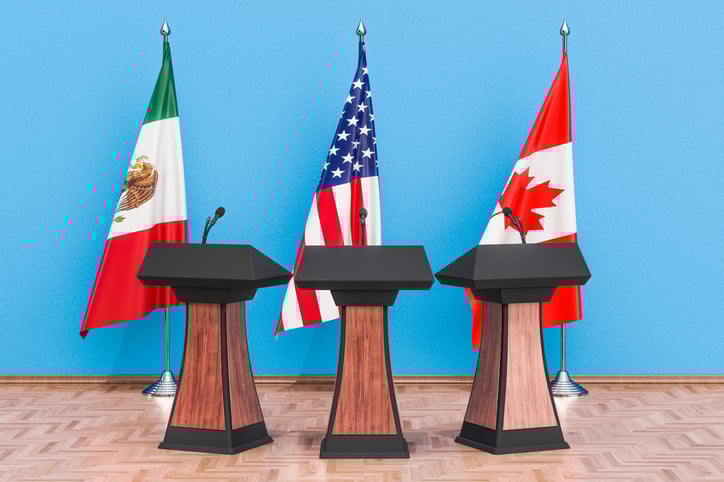
Q: With the review of the U.S.-Canada-Mexico Agreement (USMCA) looming, what are the key issues that needs to be addressed, or what changes would you recommend?
Rohlwing: As the USMCA review approaches, the goal should be to bring more certainty, not more disruption. The biggest challenges are the ongoing review cycle, complicated rules of origin, and policy disagreements that create risk for supply chains. Rather than changing what already works, the focus should be on renewing the agreement, simplifying compliance and keeping trade across North America stable and predictable.
Sevillian: The July 1 review is not a formality. It will determine whether North America secures 16 years of trade predictability or slides into annual renegotiations. Automotive, at 22 percent of USMCA trade, is ground zero. The U.S. will likely push tighter origin rules, including Origin of Capital provisions tracking where investment comes from, not just where assembly happens. The intent is shutting the door on Chinese manufacturing investment routed through Mexico. My concern, and reasonable professionals may weigh this differently, is that pushing regional value content too high could price North American production above European Union (EU) or Japanese imports entering under their 2025 deals, even with 25 percent Section 232 tariffs. Where that threshold sits is a debate worth having at this table.
On agriculture, Canada’s dairy tariff-rate quota administration continues to frustrate U.S. producers who argue it blocks allocated access, and Mexico’s genetically modified organism (GMO) corn ban was ruled inconsistent with USMCA in December 2024; a binding guarantee against future biotech restrictions should be a priority. The Rapid Response Labor Mechanism has teeth, but companies need fair response timelines before enforcement goes public. The digital trade chapter also needs a refresh for AI governance, cryptocurrency and cybersecurity.
Atasie: The USMCA review represents a critical opportunity to modernize the agreement for a more regional, resilient and digitally integrated supply chain environment. Both perspectives align on the need for clearer rules of origin, particularly in complex sectors like automotive and electronics, along with greater consistency in labor enforcement and updated digital trade provisions. Beyond that, there’s a strong case for reducing friction through faster customs processes, more predictable dispute resolution, and harmonized environmental and traceability standards to support increasingly interconnected North American supply networks. At the same time, the agreement should evolve to actively incentivize regional production of critical goods, reinforcing nearshoring trends and supply chain resilience.
Q: At this time, which industry’s supply chain is the most interesting?
Sevillian: Semiconductors, pharmaceuticals and defense all have strong claims. But the clean energy and critical minerals ecosystem stands apart because no other supply chain faces geopolitics, regulation, technology shifts and sustainability mandates converging at this scale simultaneously. Lithium, copper, nickel and rare earths are now national security priorities, not just procurement line items. China’s dominance in rare earth processing is accelerating Western nearshoring and government-backed stockpiling. Demand from electric vehicles, AI data centers and renewable buildouts is outrunning supply for materials like copper, creating a structural gap where one disruption could stall the global energy transition.
Atasie: Energy and semiconductors together underscore a key reality: Supply chains have evolved into strategic assets central to geopolitics, economic policy and technological change. Energy highlights the shift from traditional systems to renewables and critical minerals, while semiconductors reflect the global race for advanced manufacturing, national security and innovation leadership. Both sectors are navigating regionalization, heavy capital investment and complex global dependencies while striving to balance cost, resilience and sustainability.
Rohlwing: Right now, the semiconductor supply chain is the most interesting to me. It affects almost every industry and is under pressure from geopolitics, reshoring efforts and demand from AI, automobiles and energy. It’s a clear example of how supply chains are being redesigned in real time to balance risk, cost and resilience.