ISM World 2026: What Are Procurement Professionals Talking About?

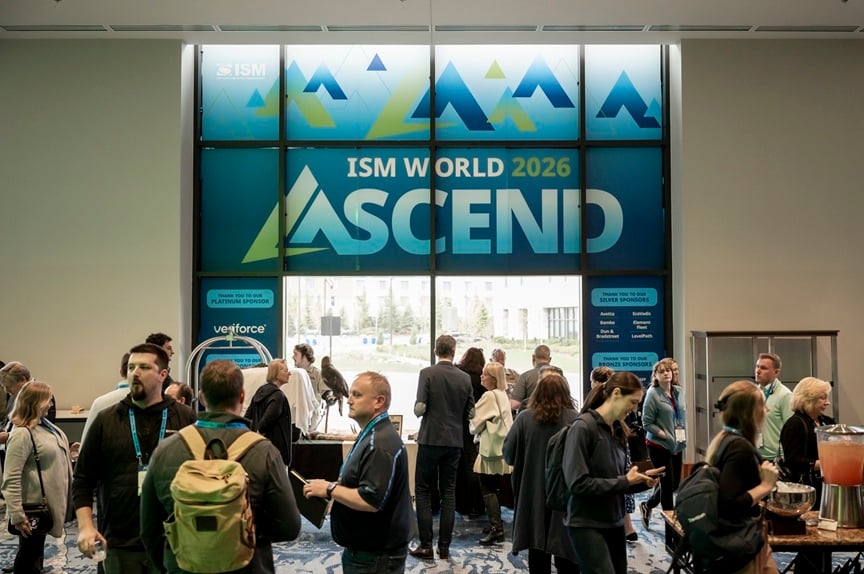
The mitigation of risk — whether relating to geopolitics, talent retention and skills, cloud technology, tariffs, how AI can help, or something else — is the hottest topic being discussed at ISM World 2026, Institute for Supply Management®’s (ISM®)’s Annual Conference, being held through Tuesday at the Gaylord Rockies Resort & Convention Center in Aurora, Colorado.
Supply chain organizations tend to be risk-averse, but the risks are everywhere — and compounding over time, Mohammed Deria, head of procurement, Americas at GSK and member of ISM’s Strategic Sourcing Committee, said on Sunday. Twenty years ago, organizations focused on logistics and supply constraint risks, he said.
“Now we’re a global community, and the risks are just added on top of each other,” Deria said. “We’re talking about how technology risk can impact your supply chain and your suppliers. We’re talking about reputational risk, and that you can have an issue with cloud that can then impact your suppliers.
“All the risks are starting to converge.”
Geopolitics, Cybersecurity and Negotiation
Mitigating risk is building supply chain resilience, something companies need given the geopolitical events that have and are impacting supply availability, shipping, costs and more, said John Atasie, MBA, managing partner at JR Global Synergy Group in Houston.
The Iran war and the Strait of Hormuz constraints have created risks beyond the obvious ones like crude oil and energy. Fertilizers and other critical materials also are shipped through the Persian Gulf area. That will impact food supply down the road, speaker Johan Gott, director, corporate advisory and consulting at Eurasia Group, said during the ISM Committees and Thought Leadership Council (TLC) meeting on Sunday.
“Shipping costs have been very, very expensive going through the other route, around the Cape of Good Hope,” Atasie said. “So, we’re all looking to see how that could get better.”
Collins Oluka, MBA, CPSM, vice president, procurement materials group — North America at Avery Denison, adds that companies are questioning how they can pass on those high costs and inflation without impacting their growth objectives.
“So, there’s a lot of focus around advanced analytics in terms of predicting the impact and then having inputs from the commercial teams to shape that number, such that procurement is going out to manage inflation,” he said. Also, discussion has centered around supporting the sales and marketing teams in supporting the business, Oluka said.
Another discussion point has been cybersecurity risk: “That’s one big issue, other than data privacy and data protection, that we’ve seen a lot of,” Atasie said. Last year, cyberattacks reached record highs. It also was a year of high cloud disruption, speaker David Weeks, head of operations at Moody’s, said during the Committees and TLC meeting.
Many organizations are considering reviewing their contracts, particularly looking at duration to create more leverage and flexibility while responding to market trends, Atasie said.
Talent Risk Management
Organizations must be future-ready for where procurement skill sets are headed, Oluka said. These skills include knowledge of geopolitics and advanced analytics, having a growth mindset, ability to innovate and build an ecosystem of suppliers.
Usually practitioners consider strategic suppliers, they think about spend and revenue impact, Oluka said. A new trend, he said, is emerging: categorizing suppliers according to where they are located, for example, in geopolitically neutral or friendly zones. “Having that perspective shapes your strategies, sustainability and parity,” he said.
It causes procurement professionals to think differently. “In the past, you would say, ‘I’m a buyer or I’m a category manager. I know my category. I negotiate and I drive value,’ ” he said.
Today, Oluka said, the questions are: Do you understand demand signals? Do you understand geopolitics? Is your strategy dynamic? What are the needs of the business? Have they changed? Are you able to communicate cost reduction or inflation management? Are you able to communicate working capital improvement and connecting that to a PO and not just payment terms improvement? Are you driving innovation? Are you working with your suppliers to innovate together and reduce time to go to market?
“All of those things require slightly different skill sets than the classic procurement type role of the past,” Oluka said. “That evolution is very important.”
***
The risks impacting supply chains have become structural — and aren’t likely to go away, the experts say. But risk can be positive: It can spark competitive advantage, Gott said. It also can lead to the possibility for collaboration and stronger decision-making.
(Photo credit: Ember Light Media)