
Supply Chain Roundtable: A Supreme Court Ruling and Middle East Conflict

Although the monthly roundtable of experts from Institute for Supply Management® (ISM®) regularly discusses breaking news and the impact on supply chains, current events rarely have felt weightier in this space than now.
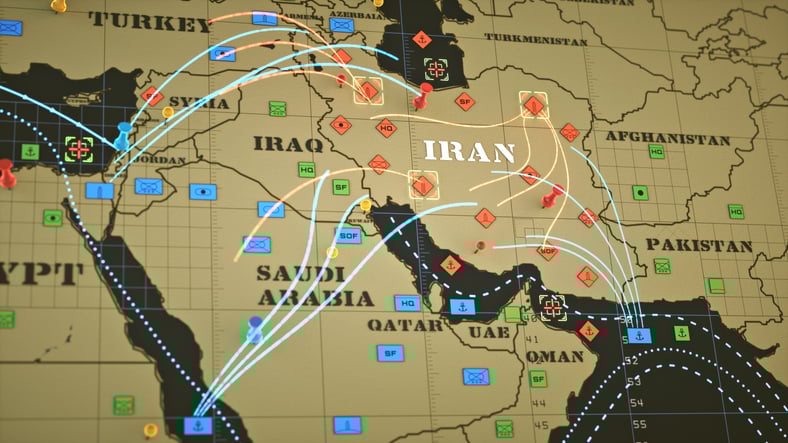
This edition deals with not one but two events in late February — the Supreme Court striking down President Donald Trump’s International Emergency Economic Powers Act (IEEPA) tariffs, and the Middle East unrest, now in its fourth week, sparked by U.S. and Israeli forces striking Iran.
Companies are dealing with a tariffs landscape that is far from settled and, in some ways, more complicated. Meanwhile, the Iran war has heightened tensions in international logistics, with the restricted Strait of Hormuz becoming a shipping chokepoint for oil and liquified natural gas (LNG), as well as critical commodities like metals and fertilizer.
The panel:
- Jim Fleming, CPSM, CPSD, ISM Manager, Product Development and Innovation
- Michelle Rohlwing, MBA, ISM Manager, Product Development, Innovation and Learning
- John Atasie, MBA, managing partner at J5 Global Synergy Group, a business and supply chain consultancy in Austin, Texas, and member of ISM’s Strategic Sourcing and Supplier Relationship Management Committee
- Lenora Sevillian, MBA, CIPP, CPPP, CPCM, executive director, community engagement at E&I Cooperative Services, a Jericho, New York-based nonprofit purchasing co-op serving the education industry.
Amid the goings-on, it’s no surprise that panelists treated the final question — which is typically designed to be fun — seriously. It’s a play off the famous Alfred Tennyson quote, and the answers provide sound advice for supply managers of all ages and experience levels.
Q: Since the U.S. and Israeli forces launched strikes in Iran, the scope and timeline of America's military presence seem to broaden with every press briefing. With energy markets on high alert, what supply chain considerations must organizations plan and prepare for?
Sevillian: The strikes on Iran have introduced a sustained “war premium” into energy markets that demands proactive, not reactive, thinking from procurement leaders. This conflict directly threatens the Strait of Hormuz, conduit for 20 percent of the world’s crude oil and LNG, and the numbers reflect it: Brent crude at US$105 to $120 a barrel, LNG prices up 50 percent, and fuel comprising more than half of maritime shipping costs.
Organizations must plan across three fronts: (1) logistics congestion from rerouting that can erode 30 percent of shipment margins, (2) demand destruction as U.S. gasoline above $3.50 per gallon compresses consumer and institutional spending and (3) a bullwhip effect as energy volatility feeds into fertilizers, petrochemicals and metals costs. In my experience, “energy independence” is largely a chimera; Hormuz disruptions raise prices for everyone. Engage suppliers now on freight adjustments, stress-test budgets for sustained $100-plus oil and front-load critical inventory before bottlenecks tighten further.
Atasie: The heightened tensions in the Middle East are increasing risks around energy price volatility and transit reliability, particularly through chokepoints like the Strait of Hormuz. Organizations should stress-test supply chains for fuel cost spikes, carrier disruptions and insurance surcharges while strengthening supplier redundancy outside the region and reassessing inventory buffers for energy-intensive operations. With energy markets on high alert, geopolitical risk must be treated as a core planning variable, supported by stronger visibility into Tier-2 and -3 suppliers to manage indirect exposure to cost increases for petrochemicals, fertilizers and transportation.
Rohlwing: The conflict raises supply chain risk, especially with energy and maritime bottlenecks. Even without a formal closure, shipping through the Strait of Hormuz can become unavailable due to security threats and insurance withdrawals. This could drive rapid increases in fuel prices, freight costs and transit times. Management should proactively evaluate supplier risk, logistics routes, inventory buffers and contract terms to ensure supply chain resilience if this volatility persists and/or escalates.
Fleming: Echoing Michelle and John, organizations should prepare for energy price volatility, transportation disruptions and extended lead times driven by heightened geopolitical risk. Priorities include scenario planning, fuel and logistics cost exposure management, supplier financial risk monitoring, and diversification of energy‑intensive and regionally concentrated sources. Strengthening supplier collaboration, contract flexibility and inventory buffers for critical materials is essential. Enhanced market intelligence, risk sensing and cross‑functional alignment with finance and operations support resilience and continuity planning globally.
Q: In the wake of the Supreme Court striking down President Donald Trump’s International Emergency Economic Powers Act (IEEPA), no supply chain professional thinks the matter is settled. Discuss the new uncertainties and supply chain strategies, particularly on new tariffs that might only have a 150-day shelf life.
Atasie: The ruling introduces greater regulatory uncertainty, with tariffs potentially appearing, shifting or expiring within compressed timelines such as a 150-day window. Supply chain leaders should prepare for a more dynamic trade environment through stronger scenario planning, flexible sourcing strategies and modular supplier portfolios. Embedding tariff and dynamic pricing clauses in contracts, adjusting landed cost models quickly and maintaining nearshoring or alternate sourcing options will help organizations stay agile amid rapid policy changes.
Fleming: Since replacement tariffs under Section 122 may expire within 150 days, supply chain leaders should plan for rapid tariff shifts by strengthening scenario planning, contract flexibility, and supplier diversification. Close coordination with finance, legal and logistics is essential to manage cost exposure, compliance risk and sourcing continuity during evolving trade actions.
Rohlwing: Trade risk hasn’t gone away, as tariffs can still come back under other authorities. For supply chains, the challenge isn’t just higher costs, but timing and whiplash. The best response is always flexibility and agility. Supply chain professionals need to build options with suppliers, manage inventory and shipment timing carefully. The trick is to avoid making big, irreversible moves based on tariffs that may not last.
Sevillian: The ruling held that IEEPA does not authorize unilateral executive tariffs, reaffirming Congress’s exclusive Article I power over duties. The decision invalidated $130 billion to $175 billion in collected duties. The administration’s bridge, Section 122 of the Trade Act of 1974, which permits a 150-day surcharge of up to 15 percent, expires on July 24; what follows is likely Section 301 or Section 232 actions with more durable legal footing but longer timelines, all under the heightened judicial scrutiny. Meanwhile, the uniform surcharge hits allies and non-aligned nations alike, reshuffling landed-cost calculations across the board.
For the 150-day window, I would prioritize four actions: (1) audit refund eligibility by pulling automated commercial environment (ACE) data now, as interest on invalidated duties accrues at roughly $650 million per month industry-wide, (2) renegotiate contracts while lower Section 122 baselines give buyers leverage — 57 percent of organizations are already planning to do so, (3) invest in independent supply chain visibility because front-loading will worsen port congestion and carrier data goes dark during peak periods, and (4) build scenario models for multiple post-July outcomes. This ruling is an immediate operational reset for our profession.
Q: A feature in the March/April issue of Inside Supply Management® focuses on circular supply chains. In your experience, where does circularity create the biggest measurable value, and what do you think will become “table stakes” for circular supply chains in the next few years?
Rohlwing: Circularity creates the most value where it lowers costs or reduces risk, especially through reuse, repair, remanufacturing and cutting waste that used to be pure expense. It also helps stabilize supply when materials are scarce or volatile. Over the next few years, I think circularity will become more top of mind. Supply chains will be focused on designing products for reuse, tracking materials across their life cycles, and building return or recovery flows into everyday operations. It won’t be a “nice to have” but a part of how companies manage cost and resilience.
Fleming: From an ISM perspective, circularity delivers the greatest measurable value in cost reduction, risk mitigation and supply continuity through reuse, remanufacturing and material recovery. These practices lower input volatility, reduce waste and strengthen supplier collaboration. Over the next few years, table stakes will include traceability of materials, life-cycle cost analysis, supplier circularity metrics and contract clauses supporting take‑back, recycled content and closed‑loop processes integrated into sourcing and category management and enterprise performance measurement frameworks globally.
Sevillian: Measurable value concentrates in three areas: (1) resilience, as closed-loop flows partially decouple organizations from the commodity volatility we are seeing in real time, (2) operational expenses reduction, as repair-and-reuse models lower procurement and waste costs when material prices are climbing, and (3) Scope-3 emissions mitigation, as circularity reduces the need for virgin extraction and energy-intensive manufacturing across the value chain. Several practices are moving from innovative to table stakes. Design for circularity will become a procurement expectation. Products that cannot be disassembled for recovery will be treated as future liabilities. AI-driven visibility into Tiers 2 and 3 will be required to maintain circularity across a material’s full life cycle. Reverse logistics will be a standard capability, not a specialty. And decision velocity, detecting change and acting with confidence in nonlinear circular flows, will separate the organizations that thrive from those that merely survive.
Atasie: Circularity creates the greatest measurable value where material recovery intersects with cost reduction — particularly in packaging, electronics, metals and high-value industrial components. Such initiatives as remanufacturing, closed-loop recycling and supplier take-back programs deliver both sustainability benefits and margin improvement. In the next few years, the bare minimum will likely include design for reuse or disassembly, embedded reverse-logistics capabilities, real-time material traceability, and supplier participation in recovery or reuse programs as a standard part of supply chain operations.
Q: Finish this sentence: In the spring, a young supply management professional’s thoughts turn to ...
Fleming: Balancing daily firefighting with looking at strategic development such as sharpening skills, strengthening suppliers, fixing forecasts, pursuing certifications and delivering value as cycles accelerate.
Sevillian: The ISM Annual Conference. This year’s gathering in Denver, themed “Ascend,” offers more than 100 sessions on topics from AI governance to tariff strategy, networking with thousands of peers, and career tracks that help emerging professionals move from tactical roles into strategic orchestrator positions. As someone who has attended, I know the connections forged at these springtime gatherings are often the ones that sustain a career through the inevitable winters of disruption.
Atasie: Career growth and new opportunities to influence strategy through strengthening strategic sourcing skills and finding new ways to deliver value beyond cost savings as budget cycles, innovation pilots, and supplier engagements begin to take shape.
Rohlwing: Cost savings, smarter sourcing and how to fix last year’s forecast before the peak season hits. For most early‑career professionals, spring is when budgets tighten, sourcing decisions ramp up and forecasts are corrected.
(Image credit: Getty Images/Matejmo)