AI Doesn’t Run the Supply Chain, Decisions Do

Editor’s note: This is the first in a series of three articles about AI and supply chains.
***
AI is often discussed as if it has introduced an entirely new way of managing supply chains. It does not.
Technologies have changed, computing power has expanded, and organizations can process more information faster than ever. Yet many of the business problems we ask AI to solve are familiar.
Supply chains have always depended on organizations making decisions about demand, supply, inventory, capacity, production, transportation, cost, risk and service. What has continued to evolve is how technology helps us make those decisions.
AI Origins
The term artificial intelligence offers a useful starting point. In 1955, John McCarthy, Marvin Minsky, Nathaniel Rochester and Claude Shannon proposed what became the 1956 Dartmouth Summer Research Project on Artificial Intelligence.
Their proposal was based on the idea that “every aspect of learning or any other feature of intelligence can in principle be so precisely described that a machine can be made to simulate it.” They proposed exploring how machines might “use language, form abstractions and concepts, solve kinds of problems now reserved for humans, and improve themselves.”
Seventy years later, the language remains strikingly familiar. Language, reasoning, problem solving, learning and the ability of machines to perform tasks once dependent on people remain central to how we discuss AI.
Even the National Institute of Standards and Technology (NIST) defines AI as a machine-based system capable of making “predictions, recommendations, or decisions” for human-defined objectives. The technology has advanced considerably, but the connection among information, intelligence and decisions has remained.
That connection is also well known in supply chain management. Decision science, operations research, statistics, mathematics and management science have long provided methods for evaluating alternatives, understanding constraints and improving decisions. Forecasting, optimization, simulation, scheduling, routing, resource allocation, pattern recognition and predictive modeling were not new to supply chains; they are now associated with AI.
Organizations have used these and related capabilities for decades to decide what to buy, what to produce, where to position inventory, how to allocate capacity, which orders to prioritize, and how products should move through a network.
Research on supply chain decision technology similarly reflects this broader history, spanning optimization, machine learning, expert systems, statistical methods and other approaches used to support decision-making.
The End-to-End Supply Chain
Digitalization has expanded what organizations can do with these capabilities. Information that once moved through paper documents, telephone calls, spreadsheets and disconnected applications is increasingly available through inventory, planning, warehouse, transportation and other enterprise systems.
Analytics, automation, optimization, machine learning, computer vision, natural language processing and generative AI have continued that evolution. These technologies are not interchangeable, nor should everything digital be labeled AI. They have distinct capabilities within a much larger digital operating environment.
This becomes particularly important when considering the end-to-end supply chain. Planning, sourcing and procurement, manufacturing, inventory, warehousing, logistics, transportation and fulfillment do not operate independently. They are parts of an interconnected operating environment in which information and decisions move across functional boundaries.
Technology supports these activities and the connections between them, but it does not replace the underlying disciplines, processes or decisions. A model that predicts a late shipment has identified a transportation issue but has not resolved it. A system that identifies supplier risk has provided information but has not determined how sourcing should respond.
A more accurate demand forecast does not decide where inventory should be positioned, just as generating a summary of a warehouse exception does not determine whether staffing, replenishment or workload priorities should change. In each example, technology can improve the information available, the speed at which it is evaluated, or the range of alternatives considered. Business performance still depends on the decisions and actions that follow.
This is where organizations can lose the link between digitalization, AI, and the business it is intended to improve. A process can become faster without delivering a better outcome.
Automation can execute a poor business rule more efficiently. A prediction can be highly accurate yet still have little value if it does not change an operational decision. An AI-generated recommendation can also be reasonable within one function while creating a problem elsewhere in the supply chain.
Decision-Making
By the time an organization asks how it can use AI, it is already at the starting point. It is looking for a business application rather than which improvements and capabilities it needs to implement the technology.
Supply chains are interconnected systems of processes, information, physical flows and decisions. Sourcing affects production, production affects inventory, and inventory positioning affects transportation, fulfillment, costs and customer service. AI can support these activities in ways previously impossible, but it does not determine which decisions have the greatest impact on performance.
That raises a different question for supply chain leaders: Which decisions are driving your supply chain performance, and which should you prioritize for improvement?
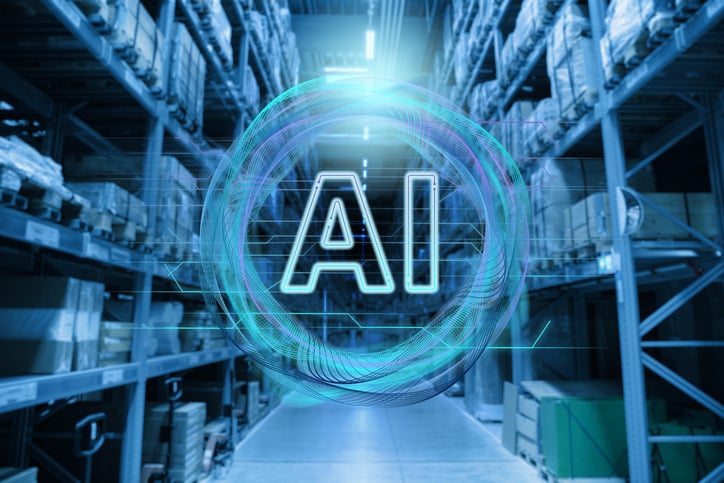
(Image credit: Getty Images/ScharfsInn86)