
U.S.-Canada Trade Tensions: The Next Supply Chains Test

Throughout both of Donald Trump’s presidencies, supply management organizations have regularly pivoted and adapted to often-madcap U.S. trade policy that can be announced on a late-night social media post and change from one week to the next.
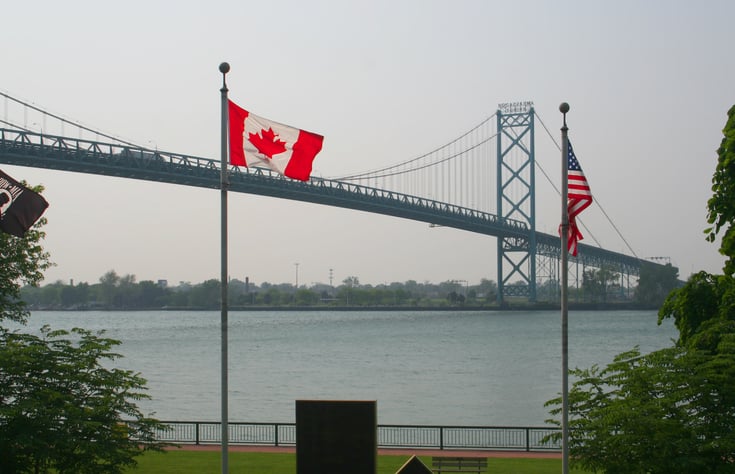
That most recent tariffs eruption, however, feels different and potentially pivotal after trade discussions between the U.S. and Canada collapsed late Friday. That impasse paved the way for new duties of 50 percent on US$20 billion of U.S. imports from Canada — a trade escalation in which Ottawa has vowed to not back down.
“The North America business community wakes up to a new tariff landscape,” Dave Townsend, partner in the global trade group at Minneapolis-based international law firm Dorsey & Whitney, said in a memo. “The biggest question now is whether this is a temporary tariff hike or will last for some time.”
The ramifications for companies and supply managers extend far beyond the borders of the three nations that are in the process of negotiations related to the joint review of the U.S.-Mexico-Canada Agreement (USMCA). As Townsend noted, American tariffs on Chinese goods elevated above 100 percent in a series of tit-for-tat actions between the countries.
Canadian prime minister Mark Carney promised “dollar-for-dollar” retaliation. On Tuesday, Ottawa made it official, with matching tariffs set to take effect on September 8.
Energy and critical minerals exports could be leveraged, an option that Ontario premier Doug Ford floated on Monday. And other nations impacted by U.S. tariffs will watch the fallout and ponder how they can capitalize — perhaps with a similar counterattack.
“Either way, Friday was destined to be a bad day for North American businesses,” Ontario Chamber of Commerce CEO Daniel Tisch told the Toronto Star. “Behind one door, we had the high costs of permanent tariffs, making a mockery of (the USMCA), and a truce that would only last until the U.S. president’s next tantrum. Behind the other, we had the madness of a continuing trade war.”
Turning Up the Tariffs — and the Heat
The new tariffs on Canadian imports were announced in late July and call for a 50-percent tax on products like paper, hockey sticks, textiles, cement, electronics, honey and candles.
The $20 billion worth of products subject to tariffs is less than a third of the $67.9 billion in cross-border freight between the U.S. and Canada in June alone, according to the Bureau of Transportation Statistics. It’s a miniscule share (5 percent) of the $383 billion of goods the U.S. imported from Canada last year.
However, it’s the level of escalation between countries that have had one of the most durable trade alliances in history — and, as Inside Supply Management® detailed in 2024, increasingly integrated supply networks — that has spooked analysts and observers.
Trump on Monday threatened to raise U.S. tariffs on all cars, trucks and automotive parts from Canada to 50 percent starting January 1. In the last year, U.S. bourbon and other spirits generally produced in U.S. states that gave their electoral votes to Trump in 2024 have been removed from shelves in many Canadian stores. Ford has recommended additional purchasing punishment for red states.
Meanwhile, Canadian businesses are bracing for more uncertainty, and many know “the pain is going to be real.”
Unlike previous rounds of duties, the latest one doesn’t exempt exports that comply with the USMCA. The new tariff rates could be a culture shock for importers that enjoyed largely duty-free buying since the North American Free Trade Agreement (NAFTA) took effect in the 1990s, said T. Augustine Lo, partner in Dorsey & Whitney’s national security law practice group.
“With Canada expected to impose countermeasures against U.S. goods, there could be severe repercussions (for goods and services trade between the countries),” Lo said in the memo. “Nearly all industries and professions are likely to see downstream effects from this spiraling trade dispute.”
‘All Manufacturers’ Are Affected
Last week, an Institute for Supply Management® (ISM®) webinar discussed how tariffs are forcing manufacturers to rethink one of procurement’s most basic questions: What does something really cost?
For companies that import a significant share of their components, it’s well beyond the supplier’s quoted price, said Tom Yanowsky, purchasing manager at Trenton, New Jersey-based machining manufacturer KNF Neuberger Inc., during “Protecting Margin: How U.S. Manufacturers Rebuilt Sourcing Under Cost and Tariff Pressure.”
Yanowsky said his company has had to put greater emphasis on total landed cost, factoring in transportation, country of origin, quality and delivery requirements. Section 232 tariffs on steel, aluminum and copper have added another layer of complexity, he said.
“Our customers have high standards on quality and delivery. They need to receive their products at a competitive cost,” he said. “So, how we do that has been challenged in the past (18 months) with additional layers of tariffs. They’ve affected all manufacturers in the U.S. The complexity has caused us to look at total landed cost for what we source globally.”
That calculation is also changing sourcing strategies. Procurement teams are constantly reassessing what can be sourced domestically, what should come from international suppliers or sister factories, and what can be made in-house.
For KNF, some machined, fabricated and commercial components can be sourced locally, while other parts still require global supply bases. The key is making those decisions quickly enough to protect margins without compromising quality or customer service.
AI-enabled systems can help procurement teams model the impact of tariffs, freight, raw-material costs and sourcing changes to help prepare for supplier negotiations. But technology does not replace the buyer, Yanowsky said: “AI does not do the work for you. It’s a tool that speeds things up (and) allows the information to be visible.”
For companies, that might be the biggest lesson of tariff volatility: It’s critical to understand the economics of each option, keep alternatives ready — and most importantly, have the information and agility to act when conditions change.
Can This Partnership Be Saved?
Townsend, the Dorsey & Whitney partner, said in the memo, “I’ll be looking for whether the parties continue to negotiate and show a willingness to avoid spiraling measures and countermeasures. Both sides have a strong interest to avoid that outcome.”
As the trade turbulence has heated up, any cooling could come from outside the Trump and Carney circles.
The new U.S. tariffs were enacted under Section 338 of the Trade Act of 1930, a U.S. trade law that is obscure and, some analysts suggest, ambiguous — which would leave it ripe to legal challenges, though that process could take months. More tangible factors are the U.S. midterm elections in November and Trump’s sagging approval ratings, both overall and on his handling of the economy.
Carney said he is open to resuming trade talks if the U.S. has the “right attitude.” Amid Trump continually referring to Canada as a subsidiary or “51st state,” the trade perspective north of the border has become a matter of cross-border respect as well as commerce.
The November/December 2024 issue of Inside Supply Management® examined Canada’s place in the global manufacturing and supply chain environments, including the country’s trading relationship with the U.S. with a second Trump administration looming.
The headline: “Power Play.” It’s even more fitting now than it was then.
(Photo credit: Getty Images/Umut Tolga Pehlivan)