Q&A: The Workforce AI Revolution

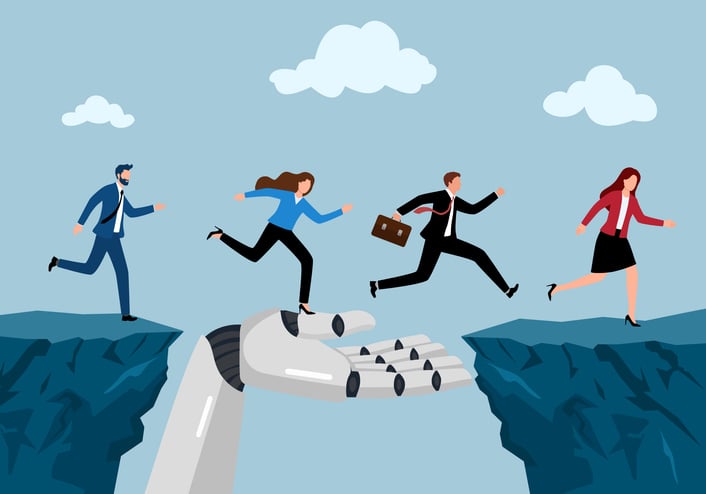
Many companies are rushing to implement AI, but the focus is often on technology while talent development is left behind — a lot of discussion about which jobs might disappear, but far less about how employees should adapt.
AI will change white-collar roles at every level. Entry-level positions will involve less data entry and more data analysis, requiring stronger coaching from managers. Managers will need to deeply understand the business, guide junior talent and connect AI insights to real decisions. Leadership will need to align AI implementation with workforce development.
Let’s examine some of the key questions and look at what to expect.
Question: Why do you compare today's AI boom to a gold rush?
Answer: We are living through an AI rush that, in many ways, resembles the gold rush of the 1800s. The promise is enormous: greater productivity, faster output and the ability to deliver more products and services with fewer traditional constraints.
At the same time, much of the conversation around AI and the job market is still speculation. The future is not fully clear, and many practical questions remain unresolved. Data centers require immense electricity and water, AI adoption is currently being supported by heavy investment, and companies are still learning what long-term dependency on these tools will mean. With so many variables at stake, it is too early to claim we know exactly where this transformation will lead.
Q: What can previous technological revolutions teach us about AI?
A: Like every major technology introduced before it, AI will transform the way we work. We saw similar shifts during the Industrial Revolution, the rise of computers and the expansion of the internet.
Each of those changes reshaped the workforce, eliminated certain jobs and created new ones. AI will likely do the same. Some roles will disappear, others will be redesigned and new opportunities will emerge.
What remains uncertain is where the balance will ultimately land between disruption and creation.
Q: How should professionals think about their place in this transformation?
A: Before focusing only on whether AI will create unemployment, every professional should ask a more immediate question: Where do I fit in this new world of work?
Some people may assume they are protected because they are not in entry-level roles, but the reality is broader. Entry-level employees, managers and senior leaders will all have to adapt. The people and organizations that embrace AI, develop new skills and prepare for change will be better positioned than those that simply wait to see what happens.
Q: What does AI mean for entry-level jobs?
A: Entry-level roles are often described as the jobs most likely to disappear, but eliminating them entirely would create a serious contradiction. These roles are the pipeline for future talent. Without them, companies lose the next generation of employees who will eventually replace retiring workers and move into more strategic positions.
What will likely change is the nature of entry-level work. Repetitive tasks, basic analysis and simple reporting may be handled increasingly by AI. In the past, junior employees learned by gathering data, building reports and making sense of the results. AI can now perform much of that work faster.
As a result, entry-level talent will need earlier exposure to real business problems, stronger coaching from experienced professionals, and more opportunities to interpret AI outputs, question assumptions, and understand business context.
Q: How should companies redesign early-career talent development?
A: Companies should not treat AI as a reason to remove young talent from the organization. Instead, they should redesign early-career roles around learning, judgment and exposure. Rotational assignments — pairing junior employees with senior peers, structured feedback and data interpretation — should become central parts of development.
New employees must learn not only what AI produces, but also how to evaluate whether the output makes sense. If companies eliminate entry-level pathways, they may save time in the short term but create long-term talent shortages.
There is also a generational shift underway. Younger workers entering the market may not approach career growth the same way millennials or Generation X did. Organizations that recognize this and build a culture suited to the future workforce will have an advantage.
Q: Will people managers survive the AI revolution?
A: Pure people management will need to evolve. Simply coordinating teams, running meetings and reporting updates to senior leadership will no longer be enough. Managers will need AI fluency, business ownership and the ability to help employees navigate decisions in a more data-driven environment.
They will also play a critical role in guiding entry-level talent, translating AI outputs into business meaning and identifying where human judgment is still required. T-shaped managers — leaders with strong human skills and a deeper understanding of the business — will become especially valuable.
The best managers will combine empathy, communication, process knowledge and the ability to foster AI adoption without losing sight of talent development.
Q: What role should leadership play in this transition?
A: Leadership will be responsible for steering this transformation from both a technology and talent perspective. Many companies are rushing into AI implementation without a clear plan for how their workforce should evolve alongside it.
In some cases, organizations have already had to slow down or rethink AI tools after seeing how they affected employees and operations. Managers often see the day-to-day challenges more clearly than senior leadership, so leaders must create space for that feedback. The challenge is not simply deploying AI; it is enabling managers and teams to use it responsibly, effectively and in ways that strengthen the organization over time.
Q: What is the most important message for workers and companies?
A: The reality is that everyone will need to adapt, from entry-level employees to senior executives. No one knows exactly where this transformation will land, but the direction is clear: AI will reshape the workforce.
That should not be a reason to fear the future. It should be a reason to learn, prepare and build better systems now. The future of work will be shaped not only by AI itself, but by the decisions companies make today about people, skills, leadership and culture.
(Image credit: Getty Images/Pasakorn Leelanupat)