
Can the U.S. Compete in Rare Earths?

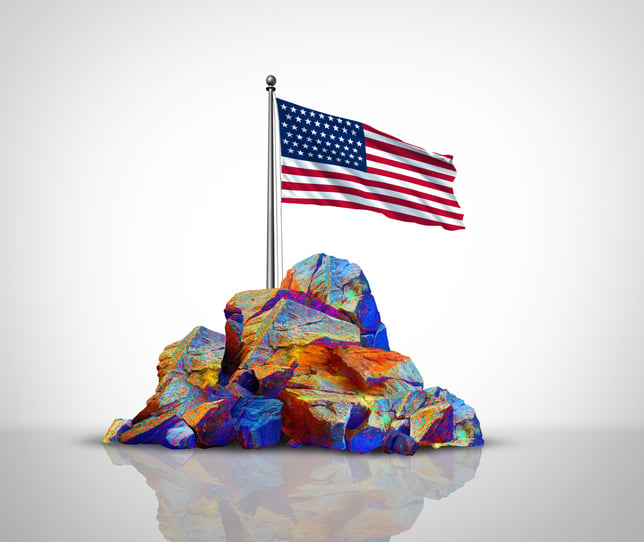
Concerns over rare earth mineral availability are nothing new.
“The issues relating to the geopolitical aspects, tariff impacts and effect on national security are more than 15 years in the making,” says Harvey Kaye, executive chair of U.S. Critical Materials, a privately held U.S. rare earth minerals exploration company based in Salt Lake City.
Fifteen years ago, the U.S., which has several rare earth deposits, was beginning to develop a rare earth industry, he says, with major companies talking with domestic suppliers.
However, China began to dominate the market — China’s Belt and Road initiative helped the country gain ownership of African rare earth mines — making it less economically viable for a U.S. market to develop. In addition to having the supply, China dominates rare earth processing.
“(E)xpanding traditional mining and processing is unlikely to overcome the scale of China’s dominance, which spans the entire critical minerals ecosystem,” the Council on Foreign Relations (CFR) states in a February report.
However, the U.S. has reached “a dangerous inflection point,” according to the report, which states, “Can it overcome its overwhelming dependence on China for critical minerals and rare-earth elements and sufficiently protect its modern industrial base from a Chinese choke hold? Absent a comprehensive strategy, the U.S. industries dependent on critical minerals, including defense, aerospace, autos and electronics, will remain at risk of Chinese (dominance).”
The U.S. has a nascent domestic market, which should provide an alternative, especially when it comes to national security issues and less reliance on China, Kaye says.
Sheep Creek
Rare earth minerals are used in electric vehicles, medical equipment, smartphones, tablets, lasers, satellites, F-35 fighter jets, drone technology, and many other applications. Among the most critical rare earth elements, according to the U.S. Geological Survey (USGS), are erbium, yttrium, cobalt, neodymium, lithium, gallium, dysprosium, scandium and iridium.
In 2024, 80 percent of the rare earth elements used in the U.S. were imported, the agency says.
“Catching up to China is a daunting challenge,” the CFR report states. It will take years. “It is hard to out-mine, out-process, or out-fund China. Rather, the United States should seek to leapfrog China’s dominance by unlocking and scaling disruptive technology, innovation, permitting and recycling.”
The Sheep Creek, Montana project, in the southwestern part of the state and one of several domestic sites for sourcing of rare earths, is taking what might be considered an innovative approach to rare-earth mineral mining. The site, which is being developed by U.S. Critical Materials, has been independently validated as rich in critical rare earth deposits.
Sheep Creek’s percentage of rare earth content — at 9 percent — is reportedly higher than that of other domestic sites, says Kaye. California’s Mountain Pass and USA Rare Earth, which has a west Texas mine and a manufacturing facility in Stillwater, Oklahoma, reportedly have lower average content.
Innovative Plans
Among U.S. Critical Materials’ plans and projects:
In April, the company announced a collaboration with Columbia University. The two-year sponsored research agreement “seeks to advance scientific pathways that enable the development of future U.S. production of gallium, scandium, titanium, and rare earth elements from red mud, a major byproduct of aluminum refining,” a Columbia University press release states.
Greeshma Gadikota, Ph.D., Lenfest Earth Institute professor of climate change at the Columbia Climate School, professor of earth and environmental engineering at Columbia Engineering, will lead the project, which is called Mud to Metal.
“Our team is focused on rigorous, environmentally responsible pathways for recovering critical metals from complex materials,” Gadikota said in the press release. “Red mud presents a significant opportunity to strengthen U.S. resource security through innovation.”
Kaye notes that the Mud to Metal project helps alleviate an environmental issue: turning waste into critically sought after minerals. U.S. Critical Materials is also working with the University of Illinois and Montana Technological University in Butte, Montana to evaluate the economics and efficiency of the mining processes.
“We are working with the University of Illinois, with access to the national supercomputer, to streamline the introduction of innovative technologies to market. Montana Technological University is collaborating to utilize its unique technologies to further explore the Sheep Creek resource,” he says.
***
Innovation is one way the U.S. can set itself apart from Chinese dominance in the rare earth minerals space — and in other areas, Kaye says. “You can't innovate if you don't have the materials for the next generation of chips or AI, or radar or defense or satellites or space travel. So, it is very existential.”
(Image credit: Getty Images/Wildpixel)