
ISM World 2026: Swisher Shoots Straight in Sobering and Spicy Keynote

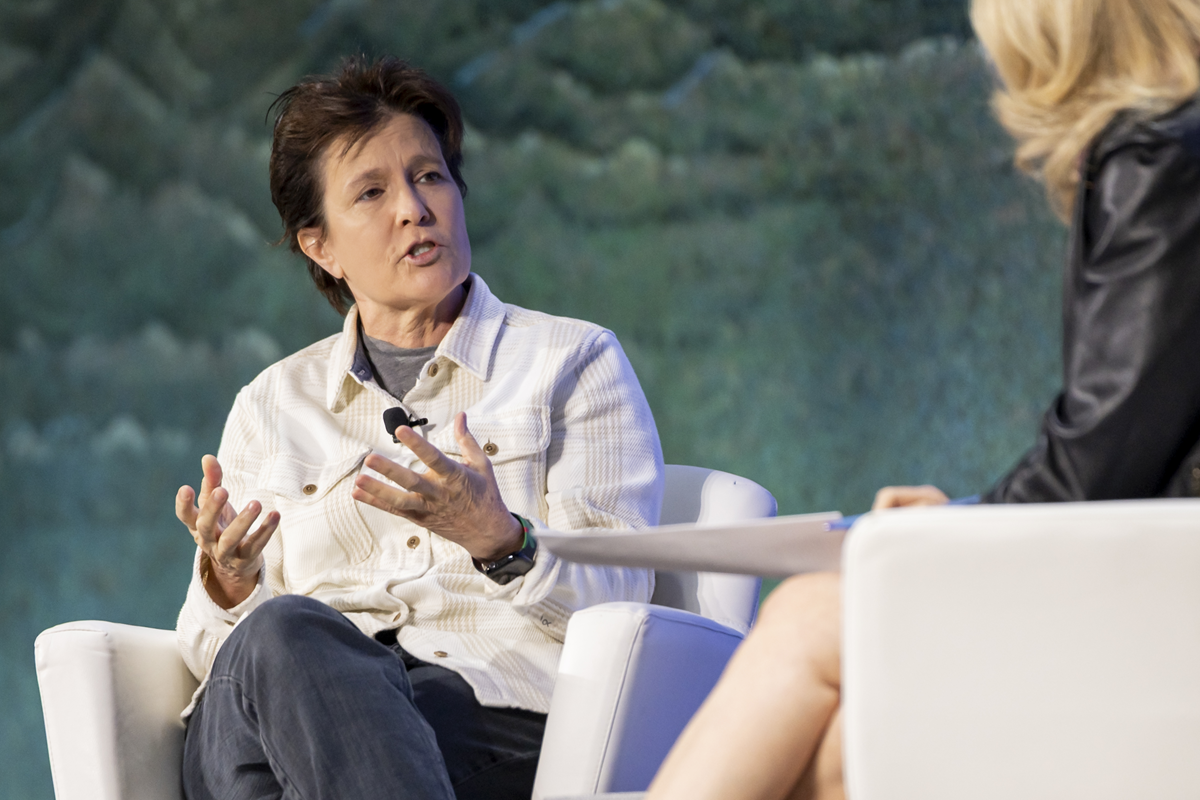
For those who know Kara Swisher as a straight-shooting, often-spicy interview participant — either in giving the questions or the answers — her keynote at ISM World 2026 on Monday did not disappoint.
The incomparably connected technology writer and podcaster is not shy about dropping an occasional expletive for emphasis, which made for likely the most colorful Opening General Session ever at an Institute for Supply Management® (ISM®) Annual Conference. More important, however, were Swisher’s timely and actionable insights for professionals and their companies on technologies that have been equally beneficial and destructive, and well as the consequences of what she called the “idolatry of innovators” behind many of them.
With AI the dominant topic during ISM World 2026 at the Gaylord Rockies Resort & Convention Center in Aurora, Colorado, Swisher devoted much of her interview on the topic, with a clear message: Companies have to use it.
“AI is a supercharged version of basically everything,” she said during an interview with Conference emcee Kelly Wallace. “But you have to figure out what works for your organization and what doesn’t — what works for sales will probably be different than for delivery.”
Eschewing AI would be the same as an organization, Swisher added, “saying, ‘These newfangled electric lights — what are we going to do?’ We’ll stick with candles.”
At the same time, she urged caution. While AI can drive efficiencies and handle routine tasks, overreliance on systems that lack human judgment comes with risk, she said: “It’s not a human-centered approach to it. It’s a machine-centered approach.”
Technology Versus Social Media
Swisher also drew a sharp line between professional and personal uses of AI and other technologies like social media.
She expressed concern about AI chatbots being used for emotional or social support, describing them as “sycophantic” and potentially harmful to cognitive development. Social media, a vital tool for many business professionals, is an even bigger mental-health minefield.
“You can become addicted to something you can’t get off of because you have to use it,” Swisher said.
Noting studies that show excessive social-media use is linked to negative health outcomes like depression, anxiety and reduced sleep — not to mention amplifying divisions and eroding trust in institutions — she added, “You need to broaden your social connections … and I don’t mean online.”
Know What You’re Talking About
Despite those criticisms, Swisher touted the benefits of technologies like AI, particularly in medicine. Advances in such areas as drug and vaccine development and gene editing could accelerate breakthroughs, though expressed skepticism of lofty claims from tech companies.
“They say, ‘We’re going to solve cancer,’ ” Swisher said. “And I’m like, ‘How?’ ‘Through AI.’ ‘Yeah, but how?’ ‘Through AI.’ ” She continued, “My dad was a doctor, but that doesn’t mean I should be doing surgery.”
Her broader message emphasized balance — embracing innovation while recognizing its risks. In the AI era, one of the biggest risks, Swisher said, is the domination by a handful of powerful companies with the resources to build and control the technology.
The cost of computing power, data centers and specialized chips has created high barriers to entry, limiting competition.
“This era is dominated by the dominators,” she said, evidenced by Tesla and SpaceX mogul Elon Musk co-leading the Department of Government Efficiency (DOGE) early in the second Trump administration. DOGE faced criticism of its use of data and information, as well as skepticism over how much cost savings it produced.
While participating in a televised discussion, Swisher said, another panelist argued that regulations were handcuffing tech companies. “Just for kicks, I asked him how many regulations there were. ‘Hundreds,’ he said,” she recalled. “I replied, ‘Actually, none. But you were close.’ ”
Swisher continued: “I'm not for onerous regulation. But I don't think the deli on my corner should have more regulation than multitrillionaires.”
There has been a shift in decision-making power away from governments and toward corporations. In that landscape, a small group of executives at trillion-dollar companies wields outsized influence over communications, commerce and even politics. “That’s always bad for innovation,” she said.
Companies Should Call for Accountability
Throughout the conversation, Swisher returned to the theme of accountability — particularly for governments and regulators. She challenged audience members to press their companies to advocate for policies that ensure fair competition, protect data privacy and address workforce disruptions.
Without such measures, she warned, companies could become increasingly dependent on a small number of providers who can name their price. “Their motto has been, famously, to move fast and break things,” Swisher said. “Well, when that happens, who fixes them? And who pays to get it fixed? All of us.”
Through it all, Swisher is bullish on America and optimistic for the future: “I wouldn’t have four kids if I wasn’t,” she said.
While at Georgetown University in the early 1980s, she had ambitions of becoming a CIA agent or joining the military — but those paths were closed to her at the time because she is gay. Swisher found her service calling in journalism, where much of her work, she said, is framed by her responsibility as a parent.
For now, her focus remains on the present, a moment she sees as both transformative and fraught. As AI reshapes industries and society, Swisher’s message to attendees was clear: Engage with the technology, but ask questions and push for accountability.
“How can you use it? And how can you protect your businesses?” she said.
(Photo credit: Ember Light Media)