ISM World 2026: Shipman Panel Talks About Turmoil, Tech and Talent

As AI revolutionizes supply management — possibly at a pace too fast for many companies to keep up — the success of the profession in the coming years will still be powered by people, a panel of J. Shipman Gold Medal Award winners indicated on Tuesday.
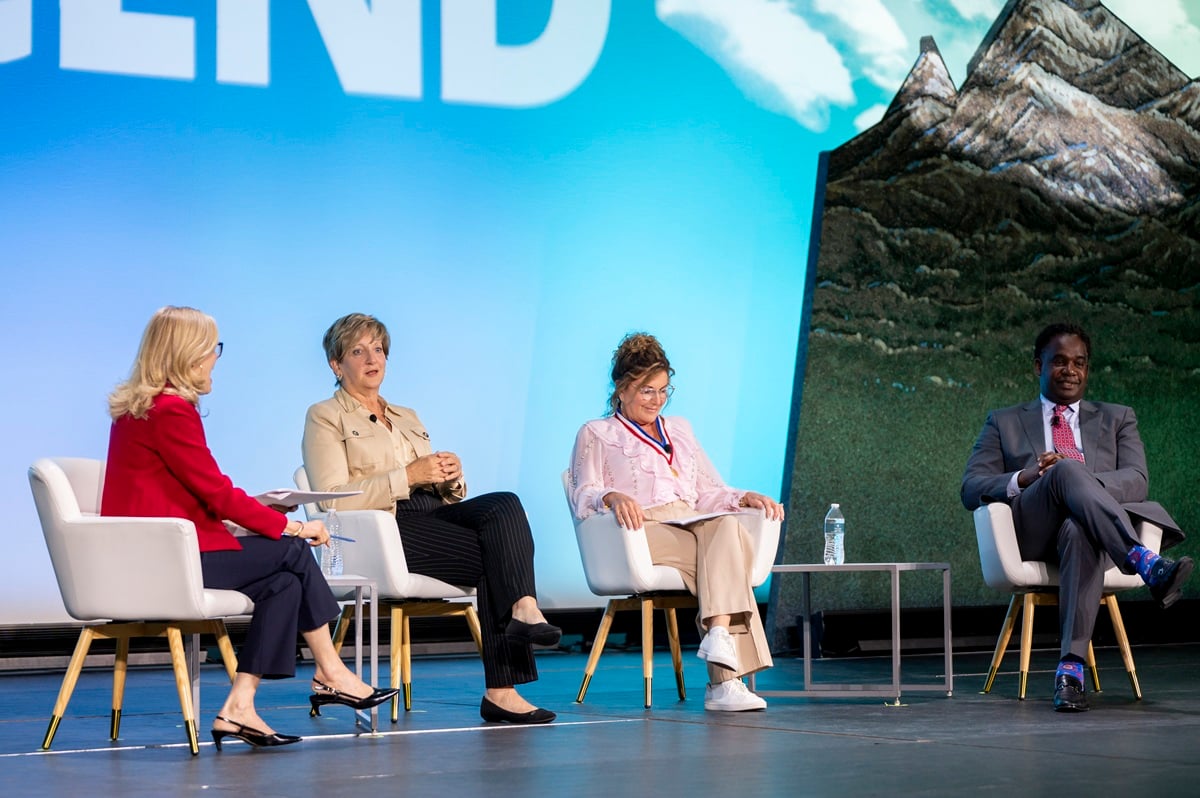
During the Closing General Session of the ISM World 2026 Annual Conference at the Gaylord Rockies Resort & Convention Center in Aurora, Colorado, the newest Shipman Award medalist, Farryn Melton, implored attendees that being bold and trusting their instincts will help them protect their companies.
“(As supply chain professionals), you see many things the business is not going to see, or at least see right away, and you need to be bold enough to help stop it from jumping off a cliff,” said Melton, president and CEO of Strategic Edge Advisories.
She added, “Help the organization do the right thing, even if it’s hard. That’s my big takeaway from here: Your job is so important, and when you trust your instincts, you can be bold and speak up.”
Melton was joined by Shipman winners Susan Spence, MBA (2020), Chair of the Institute for Supply Management® (ISM®) Manufacturing Business Survey Committee, and Craig Reed, MBA, CPSM (2025), vice president of global procurement at Thermo Fisher Scientific. Conference emcee Kelly Wallace moderated.
Procurement Sees It First
Supply managers being on the front lines is hardly a foreign concept for Spence; she is the face of the ISM® Manufacturing PMI® Report that exemplifies this dynamic. Asked her advice for executives, she said, “I can’t say it enough: Listen to your (supply chain) people. … That will help foster resiliency.” Her other suggestions: (1) set a high bar for employees, but give them room to fail and (2) make it about the customer.
Reed acknowledged supply managers’ pursuit over the years for a spot at the company table. In general, the coronavirus pandemic finally provided it, but supply management “tends to be a humble function,” he said. He advised procurement organizations to tout their successes, but always in the context of how they help achieve company objectives.
To extol procurement’s successes, panelists advised storytelling, which can be more compelling and effective than a data dump. And be humble, Melton said.
“You have to find a way to talk about successes and challenges in a way that is disarming and that gives the business partners and the stakeholders the feeling that you’re in it for the success of the company and not for the success of your organization,” she said. “That shows you're creating a vision and helping people.”
Added Reed, “You don’t get much credit for the crisis that nobody else saw.”
Crises, Decision Points and AI
In today’s supply chain environment — in fact, for at least since early 2018 — crises have seemingly been around every corner. The most recent disruptions stem from tariffs turbulence and conflict in the Middle East. Sagging consumer sentiment exacerbates the chaos, which Melton said can cause employees to “close in,” hindering productivity.
It’s then, she added, that procurement leaders need to provide clarity and stability. Reed echoed that sentiment, adding that organizations cannot sacrifice either for speed; “It’s not easy right now, but you have to be sure that you’re taking the time to understand the situation so that you are not overreacting,” he said.
At some point, supply managers might have to be comfortable with making a decision when they feel they don’t have all the information. But he added, “Sometimes the best action is no action. That’s been tough when you’re pressured to do something. … Protect the business, protect the people, and that will help you come out the other side instead of just trying to do something.”
That’s also a good philosophy for companies to have on AI, which was far and away the topic most discussed at Conference. As Reed put it, “Go slow to go fast.”
Melton advised attendees to rely on playbooks used for other technologies, noting that companies worked through previous hype cycles.
“AI is much more fundamentally changing of our processes than anything we’ve seen before; I’m not trying to dismiss that,” she said. “Even though none of us have seen anything of this magnitude, use your own past around technology to your advantage and to make a use case (for AI).
“Understand what your business needs with AI and where you can use it, make a path and pivot where needed. That way, you’re not making investments that may not pan out.”
Spence advised learning effective prompts and quality data input, citing the garbage-in, garbage out concept. “You don’t want to be the guy who turns on an agent or a bot and nothing happens because what you put into the tool (was insufficient),” she said.
’We’re Going to be Fine’
The sea change in technology, Reed said, can work to supply managers’ advantage because like with potential disruption, they see many of the dynamics first.
“I think we are in a very unique position in this overall process,” he said. “We have the opportunity to see it all first and introduce it to our organizations, helping them understand how to use it to make the business better.”
The supply management talent pool of the future is well-equipped to have that kind of impact, Spence believes. Noting the ISM international Student Case Competition competitors and other students and emerging professionals at the Conference, her message was clear: The kids are all right.
“We’re going to be fine,” she said. “I think that’s an important thing for leaders to know. If you’re a mom or a spouse or partner, I know you’re supposed to always say things will be fine, but we can say that (in business). Because of the talent and companies recognizing the importance of the function, I feel very optimistic.”
(Photo credit: Ember Light Media)