
Supply Chain News Roundup: AI and Automation Will Change Disruption Management

Think about five years from now: What will you be doing? Rather, how will you be supporting your company’s supply chain?
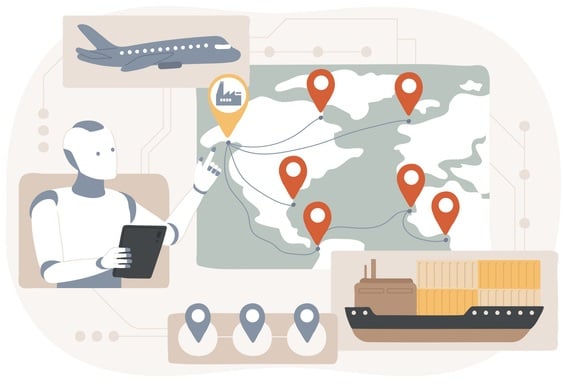
According to research by Gartner, 60 percent of supply chain disruptions will be resolved without human involvement by 2031. That’s because supply chains are becoming increasingly autonomous due to AI, the Stamford, Connecticut-based business and technology insights company says.
Organizations are finding it harder to manage disruptions like trade uncertainty and geopolitical conflicts without the use of technology — particularly real-time analytics and automated risk analysis. As a result, Gartner says, many chief supply chain officers (CSCOs) are embracing agentic AI capabilities or expect to do so within two years.
“As more frequent and complex disruptions continue to test response capacity, organizations are moving toward AI that can sense and act in real time to improve the consistency and speed of decisions,” Julia von Massow, director analyst in Gartner’s supply chain practice, said in a statement. “CSCOs should focus on expanding autonomy in a controlled manner by starting with low-risk decisions and building the data and governance needed to grow automation capabilities responsibly in the coming years.”
To create an AI-enabled supply chain capable of managing disruption with human involvement, Gartner recommends CSCOs take the following actions:
- Own responsibility for supporting an enterprise-wide AI strategy and roadmap that aligns technology investments with objectives including disruption management and decision automation.
- Prioritize investments in data quality and governance so autonomous supply chain technologies can access accurate, timely, and complete supply chain information, supporting trusted decisions aligned to potential regulatory guidelines when managing disruptions.
- Budget ongoing resources to assess the emotional and performance-based impact of increasing autonomy on existing supply chain roles, treating change management as a core workstream.
- Develop contingency plans, including protocols for rapid human intervention, should autonomous decisions fail; these plans should be supported by governance and performance management frameworks.
Get Ready for More Automation
Automation is giving warehousing a make-over: Service levels are increasing as use of automation rises, according to research from Prologis.
The San Francisco-based industrial real estate investment trust’s Applied Automation in the Warehouse Boosts Value Across Stakeholders report found that around 30 percent of logistic space has automation, compared to 20 percent to 25 percent five years ago. Automated guided vehicles and autonomous mobile robots are among the technologies being used.
Modular systems also are popular, as they require about a third of the capital needed for fully automated solutions while typically delivering greater value — 1.5 times more throughput per dollar invested, according to the report.
Other findings:
- Fully automated systems remain rare; they are used in only 3 percent to 5 percent of warehouses.
- Warehouses with automation have higher tenant retention rates and longer lease terms.
- “Automation is becoming a competitive differentiator in retail: Nearly all of the top 30 North American retailers are deploying it — and those adopters have gained (more than) 700 basis points of market share since 2019,” a Prologis press release states.
Restructuring Sourcing in Retail
TradeBeyond’s Retail Sourcing Report for the first quarter of 2026 found that the sourcing landscape is defined more by fragmentation, volatility and strategic realignment than by crisis.
Regional and diversified sourcing are taking the place of the linear supply chain model, particularly as tariffs expand and geopolitical tensions persist, the Hong Kong-headquartered provider of retail supply chain solutions reported.
“Global sourcing hasn’t slowed down, but it is being restructured,” Nicole Brackett, enterprise account executive at TradeBeyond, said in a press release. “Retailers are balancing cost with resilience, building more agile supply networks that can adapt quickly to tariffs, trade policy changes, and ongoing disruption.”
Other findings include:
- Tariffs are accelerating supply chain transformation.
- Global growth remains resilient but subdued.
- Retailers are shifting toward nearshoring and multihub-sourcing models. There has been increased activity in Mexico, Southeast Asia and South Asia.
- Trade fragmentation has increased — countries are forming “new alliances and (introducing) policies designed to protect domestic industries.”
(Image credit: Getty Images/Visual Generation)