
Iran War Shows Disruption Has Become the Name of the Game

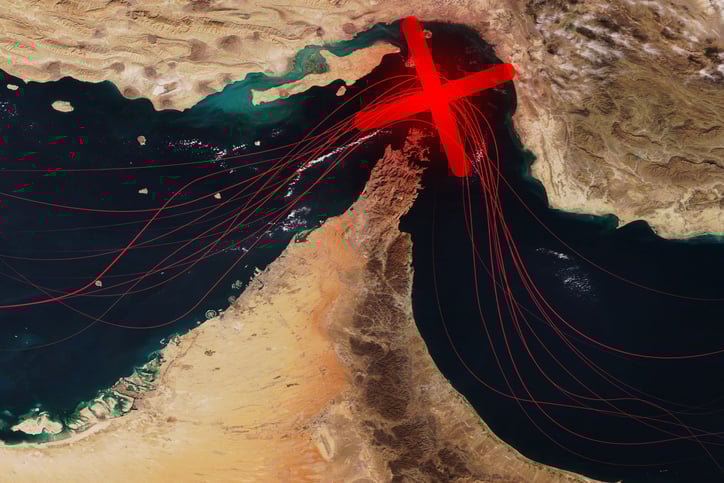
The Iran war is disrupting supply chains, driving up oil prices and causing shipments to be rerouted. But it is not the only dynamic impacting supply, lead times, logistics, decision-making and planning, and more.
We’ve reached the point where disruption is more common than not.
Though the war in Iran has been “very disruptive,” says Dean Alms, chief product officer at Aravo, risk management solutions company headquartered in San Francisco, it is one in a long line of increasingly pervasive issues challenging global supply chains. They include weather and climate — like the snowstorm that recently blanketed the Northeast, tornados in the Midwest and seasonal hurricanes — along with environmental concerns, inflation, unethical business practices and customer/consumer backlash.
Don’t forget cyberattacks. “They can pop up anywhere,” Alms says, and aren’t typically tied to geopolitical or weather events.
So, with disruptions happening all the time, companies need to be constantly vigilant and prepared: They need to have the resilience to pivot at all times, not just during whatever the current crisis may be, he says.
The No. 1 Blind Spot
It’s visibility into all levels of suppliers.
“Geopolitical disruption exposes the blind spots in global supply chains,” says Melanie Nuce-Hilton, senior vice president of innovation and partnerships at GS1 US, the global, nonprofit standards organization. “Many companies understand their direct suppliers, but far fewer have visibility into supplier networks further upstream, where critical material and component risks often sit.”
For example, Alms says, a company might not know that a primary supplier has 17 operations around the world, one of which is in the Middle East and is heavily impacted by the Iran conflict. So, they can’t determine where risks might occur now or in the future.
Having more complete data, he says, enables companies to identify and manage risks effectively, thus becoming more resilient:
- Map your supply chain. Learn where lower-tier suppliers are located.
- Run what-if scenarios. This can identify areas of volatility, particularly in situations like cyberattacks not tied to geopolitics.
- Implement risk management solutions and AI. Ensure all systems talk to each other. All too often, Alms says, companies have fragmented risk management solutions, which creates challenges in obtaining a unified view of supplier risk.
- Use third-party providers to aid supply chain visibility and risk management.
Reshoring, finding alternate suppliers in other regions, and sourcing or manufacturing closer to home are some of the strategies touted for reducing geopolitical risk. But they might not be feasible, depending on the organization. These take time and can be costly to implement, Alms says. Consolidating suppliers or manufacturing locations could create additional risk.
Visibility and Shipping
Visibility also is critical in shipping, particularly in times like these, where standardized product identification and consistent data-sharing across trading partners can add in compliance, mitigate geopolitical shipping disruption and aid in traceability, Nuce-Hilton says.
Without those, it becomes difficult to see how shifting shipping routes or regional instability will affect supply availability, she says.
“Visibility turns disruption into a decision point instead of a surprise,” Nuce-Hilton says. When companies can see where products are coming from and how they move through the network, they can reroute shipments earlier, rebalance inventory, and coordinate with partners before delays escalate, she says.
These standardized identifiers can help:
- Global trade item numbers (GTINs) help ensure every partner in the supply chain is referencing the same product data, which can make those decisions faster and more accurate
- Electronic product code information services (EPCIS) help companies share data across trading partners, so everyone can see where products are and how they are moving through the supply chain.
Disruption Is a Certainty
By not having supply chain visibility, companies are making decisions with incomplete information, Nuce-Hilton says.
“That can lead to slower responses, higher logistics costs and limited ability to explain delays or shortages to customers and partners,” she says. “When a disruption like the conflict we are seeing in the Middle East affects global shipping routes, companies that cannot trace products or verify supply data are often the last to see the problem and the slowest to respond. In many cases, the issue isn’t just a lack of data, it’s the lack of shared standards that allow trading partners to exchange product and shipment information in a consistent way.”
In an era where uncertainty is around every corner, disruption is a certainty. Companies should acknowledge that disruption is a constant, Nuce-Hilton says.
“Businesses that maintain clear visibility into where products originate and how they move through the supply chain are better positioned to identify risk early and adjust sourcing or logistics before disruptions spread,” she says, no matter the type of disruption.
(Image credit: Getty Images/Alones Creative)