
Tariffs Force Supply Chains Into Permanent Risk Mode

Tariffs are no longer a temporary disruption or a negotiating tactic that supply chain leaders expect to fade.
Instead, they have become a standing feature of the global business environment — complex, unpredictable and increasingly intertwined with geopolitics, productivity pressures and customer commitments.
That was the clear message from a recent Institute for Supply Management® (ISM®) “Quarterly State of Risk” webinar focusing on tariffs, where two senior supply chain executives described how their organizations are adapting to what they see as a long-term reality of volatility rather than a passing policy phase.
The discussion, moderated by former ISM CEO Thomas W. Derry, featured:
- Alan Harrah, CPSM, CSCP, senior director of strategic sourcing at Daikin Applied Americas, a Minneapolis-based manufacturer of heating, ventilation, and air conditioning (HVAC) products and systems
- VT Rajeshnath, Minneapolis-based senior vice president supply chain management at Pentair, a global water solutions provider headquartered in London.
“This continues to be an issue … it’s not going away,” Derry said as he opened the session. “I don’t see this slowing down. I see this continuing — and probably even becoming more complex.”
In recent days, President Donald Trump increased tariffs on goods from South Korea, from 15 percent to 25 percent, and threatened to impose 100-percent tariffs on Canada over that nation’s trade deal with China. Adding to the anxiety: The U.S. Supreme Court has given no signals on when it will issue a long-awaited ruling on Trump’s authority to unilaterally impose broad tariffs under the International Emergency Economic Powers Act.
For companies with deeply globalized supply chains, tariffs have become a multidirectional risk. The response, executives said, requires integrated strategies that reach far beyond traditional procurement levers.
Tariffs Become a Structural Challenge
At Daikin Applied Americas, tariffs arrived against a backdrop of rapid growth and operational complexity. The company is part of Japan-based Daikin Industries.
“We’ve been hit with challenges from tariffs that have been high risks in our business,” Harrah said. “We’ve had to do some very extraordinary efforts to make sure we can service our customers and be profitable.”
Harrah recalled that in December 2024, prior to Trump taking office, Daikin’s global leadership requested a detailed tariff impact assessment and countermeasure plan — without adjusting revenue or income targets.
“The message was clear,” he said. “We had to adapt. There was no retreat.”
Executives ultimately estimated that tariffs could add roughly 5 percent to Daikin’s cost base — a level Harrah described as “crippling” if left unaddressed. Instead, the company pursued productivity improvements, value engineering and supply base restructuring. This year, Harrah said, productivity gains are expected to exceed the total tariff impact.
For Pentair, the challenge was similarly daunting: “We had a huge number in front of us to offset,” Rajeshnath said. “Productivity was the most reliable lever we had.”
Pentair built internal models based on volatile, uncertain, complex and ambiguous (VUCA) scenarios to prepare teams to respond faster than external disruptions. That groundwork proved critical when tariffs intensified.
“We created certain models around the environment,” Rajeshnath said. “That helped us move quicker when change hit.”
New Sourcing Solutions at the Forefront
The executives — both members of the ISM—Twin Cities Board of Directors; Hannah is the chapter’s President — emphasized that tariff management is no longer just about negotiating supplier pricing. It increasingly involves reshaping manufacturing footprints and diversifying geographic risk.
Daikin has spent the past five years dramatically changing its supply chain structure. About 90 percent of its current operations are based in North America, Harrah said, following extensive reshoring and consolidation. The company has also shifted about 70 percent of its China-related spend to Mexico or domestic suppliers.
“The goal wasn’t to exit China,” Harrah said. “It was to de-risk China.”
Pentair has taken a similar approach, moving major production lines from Germany to Mexico and other locations — transitions that often require years of coordination with suppliers. “You can’t expect suppliers to move factories overnight,” Rajeshnath said.
To support those decisions, Pentair built a supply chain control tower in 2021 and ’22 to gain visibility into Tier-2 and Tier-3 suppliers. That capability helps sourcing teams assess which suppliers can realistically support partial volume shifts when tariffs or disruptions arise.
Dual sourcing is essential for both companies. Daikin used a metrics-driven approach to “flip the script,” as Harrah put it, on its supply base — from more than 70 percent single- or sole-sourced to one that is now more than 70 percent dual sourced.
Rajeshnath cautioned that dual sourcing must be applied selectively. “It has to be strategic versus just tactical,” he said. “Otherwise, you create cost without reducing risk.”
Engineering, Productivity and Supplier Accountability
Both executives stressed that no single tactic can offset tariff pressures. True resilience requires alignment across engineering, supply chain and operations.
At Daikin, engineering and supply management teams are now tightly integrated through a central engineering organization. Value engineering has become a key lever: “There are significant rationalization opportunities and material substitution opportunities,” Harrah said.
Supplier conversations have also evolved. Daikin follows a principle from its Japanese parent that tariff impacts should be shared, generally on a 50/50 basis, unless suppliers present meaningful offset plans.
“If someone comes in asking for increases with no countermeasures,” Harrah said, “they get a blank stare.”
Pentair takes a similarly disciplined approach, requiring tariff backup documentation, Harmonized System (HS) code validation and deep questioning of supplier claims.
“We train our teams to go seven questions deep in trying to understand if they have built resilient supply chains to avoid tariffs,” Rajeshnath said.
Supply Chain Moves to the ‘Front Seat’
At both companies, supply chain elevated its role within corporate leadership. Rajeshnath said the function moved from “the back seat” to “the front seat,” with executives and boards seeking insight into tariff exposure, inventory risk and customer impact.
“It always helps to do the right thing when you’re sharing information,” he said.
Harrah described a similar shift at Daikin, where the supply management organization earned a “seat at the big table” during the coronavirus pandemic and has retained it: “Now, we’re involved in pricing strategies, customer conversations and growth decisions,” he said.
Both executives agreed that tariffs are unlikely to ease, as evolving trade agreements and geopolitical tensions suggest continued volatility.
The lesson, Derry said, is that tariffs cannot be addressed with temporary fixes. Resilience, productivity and cross-functional alignment are no longer emergency responses. They are permanent capabilities — and, increasingly, competitive advantages.
“This isn’t about silver bullets,” he said. “It’s about looking across the entire business.”
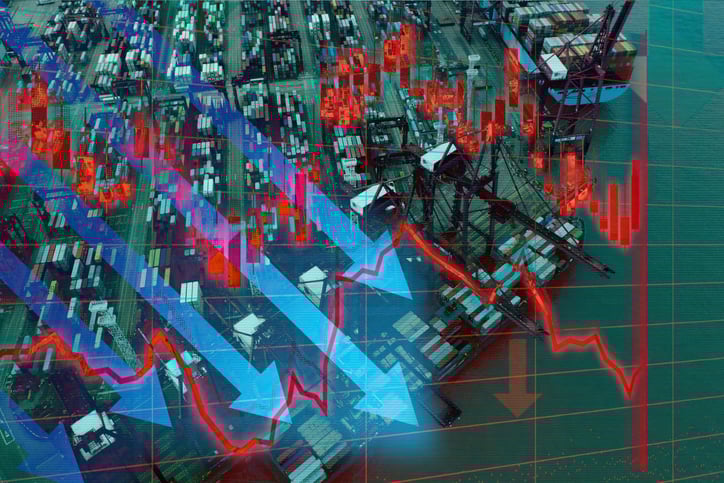
(Image credit: Getty Images/Douglas Rising)