
Supply Chain Roundtable: New Year, Same Concerns and Challenges

For supply chain professionals, there is no such thing as easing into the new year.
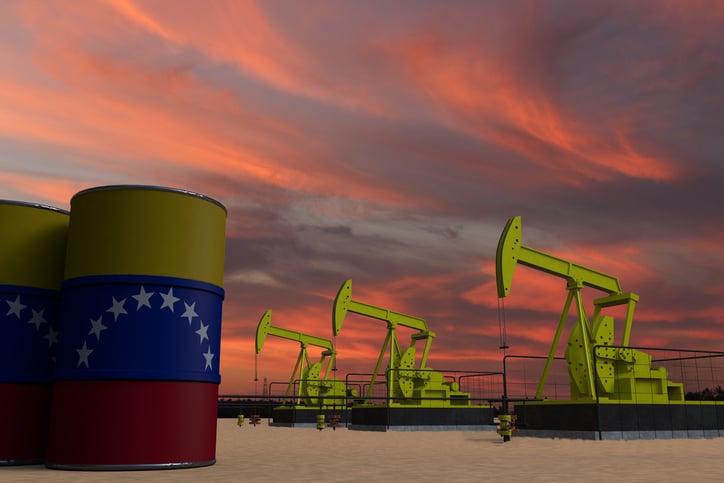
That’s been especially true in recent years, but events during January haven’t given much hope to those hoping to take a breath after an eventful, if not chaotic, 2025. Regime change — or, as some want to call it, “regime management” — in Venezuela figures to have lasting impacts on oil and gas supply chains, and a new year always brings projections and potential pitfalls regarding the U.S. and global economies.
The roundtable of experts from Institute for Supply Management® (ISM®) — Thomas W. Derry, ISM CEO; Jim Fleming, CPSM, CPSD, Manager, Product Development and Innovation; Michelle Rohlwing, MBA, Manager, Product Development, Innovation and Learning; and Linda Aaron, MBA, Subject Matter Expert — discusses those current events.
Also, with the current issue of Inside Supply Management® featuring articles on the Incoterms as well as “treasures” for supply chain resiliency, the panel added its insights.
Q: You might or might not be an oil and gas expert, but knowing what you know about establishing production and supply chain infrastructure, what are the challenges with Venezuela’s oil industry?
Rohlwing: I am definitely not an oil and gas expert. However, I’ve been reading a lot about this and from what I’ve read, it sounds like a mess. Due to years of mismanagement, the workforce and infrastructure seem to be gutted. It would take massive amounts of money, stability and expertise to get it back on track. Add (1) U.S. sanctions that block buyers, (2) shipping challenges, (3) the amount of diluents needed to move the oil and (4) crumbling pipelines and storage, the system just can’t function the way it used to.
Derry: ExxonMobil chairman and CEO Darren Woods called Venezuela “uninvestable” in a White House meeting that included President Donald Trump. I think the cost benefit analysis will come down to whether it’s faster and cheaper to build new infrastructure from the ground up, rather than trying to repair and rehabilitate.
Fleming: As Michelle and Tom highlight, the Venezuela infrastructure is going to require a significant investment by someone. The oil reserves are thought to be the highest in the world and consist mainly of heavy crude. The variations of crude create another supply chain challenge, the capacity to refine. Most U.S. refinery capacity was constructed years ago to process heavy crude oil. And most of the U.S. based oil being pumped via fracking consists of a different type, light crude. So, the U.S. refinery capacity cannot process this at the rate needed. Think of the analogy of building Chevrolet Corvettes in a Toyota Tacoma factory starting tomorrow — that would not happen. A long-term supply chain strategy for the U.S. must incorporate a significant investment in refinery capability and capacity to optimize customer demand.
Q: Looking at the state of the economy, what is your biggest key takeaway or concern from a supply chain standpoint?
Aaron: My biggest takeaway is that we are once again in a period of transition where strong and steady leadership becomes essential. History has shown us that some of our most significant gains as a profession came from navigating similar moments, whether it was the post‑2008 recovery or the early rebuilding phases after the coronavirus pandemic, when collaboration and clear communication helped organizations regain momentum. We have learned that uncertainty can actually create an advantage for teams who stay grounded, know when to reach out for help, and build alliances based on capability rather than operating in isolated segments. What concerns me most today is the strain prolonged volatility places on people and relationships, which are the backbone of every supply chain. This is the time for leaders to guide with humility, strengthen partnerships, and keep our systems flexible so we can support both our teams and our operations as the economic landscape continues to shift.
Derry: Manufacturing demand remains weak, with a continuing dampening effect from U.S. tariffs.
Fleming: Continuing to focus on risk management and scenario planning is critical. So many variables exist in the global ecosystem that a resilient supply chain must have a robust supply market analysis. Whether it is the economy or wars, geopolitical situations, strikes, earthquakes, hurricanes, droughts and the like, supply chain health drives a competitive advantage. Some of the most successful companies continue to invest in AI technology to accelerate this advantage.
Rohlwing: My takeaway is the fragility of the global routing system. The Red Sea situation is still shaky, but if carriers feel safe again and shift back to the Suez Canal route, that could add a sizeable amount of capacity into the market at once and possibly trigger congestion and rate chaos. At the same time, the Panama Canal droughts mess with routing reliability. Things aren’t in meltdown mode, but they aren’t steady, either.
Q: Halfway through the current Incoterms cycle, they seem polarizing: One camp feels they provide simplified, critical guidance for buyers and suppliers; another believes an overhaul is called for. In your knowledge or experience with Incoterms, what’s more necessary: tweaks or a teardown?
Derry: It’s always useful to have defined terms and clarity on responsibilities and risk transfers. I’m skeptical on whether expanding Incoterms’ “mission” to cover areas like sustainability reporting adds much value, although we’re overdue an update for the modern, digital age.
Rohlwing: Incoterms don’t need to be blown up — they just need some polish. The basics still work fine for spelling out who handles what, but the messy complexity that’s evolved in modern logistics just needs clearer language and a few updates. For example, the moving parts that are included now like multimodal shipments with multiple handoffs before cargo even leaves the original country. So, more of a tuneup than a teardown is needed, in my opinion.
Fleming: I am in the camp of tweaking the Incoterms. While they can be viewed as complex, Incoterms are dealing with a supply chain that continues to become more and more complex. Regardless of the direction, AI-based solutions are being incorporated into companies. AI is increasingly used to analyze historical trade data and optimize Incoterm selection, helping companies make better decisions, estimate costs more accurately, and streamline cross‑border buying and selling. Such solutions can drive Incoterms optimization.
Q: An article in the January/February issue of Inside Supply Management® discusses a “treasure chest” of strategies to withstand tariff-driven and geopolitical volatility. In your eyes, what are the “jewels” for resilience in 2026?
Fleming: Technology, technology, technology … I am seeing many AI-based solutions come to market that are focusing on such challenges. These solutions provide rich (though not perfect) data and information to supply chain professionals and enhancing decision-making processes. While the data may not be perfect, you should be able to move forward quickly with 75 percent to 85 percent directional accuracy. A quote has always stood out in my mind, “Perfection is the enemy of excellence.” If we wait for perfect data in today’s complex world, it is game over. Nimble and robust corporations adapt quickly, using resources they have available while striving to improve real time.
Rohlwing: Some “jewels” for resilience come down to keeping your options open, knowing your suppliers inside and out, and staying flexible when things shift. In practice, that means having multiple routes and sourcing paths ready to go, building visibility beyond just Tier‑1 vendors, and using contracts that let you pivot fast when markets or geopolitics change. Contracts can no longer be focused on securing a low rate and moving on. These “jewels” are just a few that help organizations to roll with punches — instead of getting knocked down by them.
Derry: Regarding tariff volatility, here are the options in the treasure chest: negotiate sharing the tariff with your supplier, re-engineer the component to be tariff exempt, move production/sourcing to a lower-tariff country, absorb the tariff and increase prices to customers, find non-tariff offsetting cost reductions elsewhere in the business, or persuade the government to rescind the tariff due to unique capacity and technology constraints that limit alternative sources. Most companies will use some combination of the above.
(Image credit: Getty Images/Alexander Sanchez)