
Selections for a Supply Chain Book Club


As an avid and enthusiastic bookworm, my favorite social media post each year highlights what I’ve read over the previous 12 months.
When the 2025 edition of that post goes live at the end of the month, it will report that I completed 30 books, a personal best. Other than the timeless Kurt Vonnegut, I gravitate toward nonfiction, on topics from current events to history, sports to music, science to business.
As 2024 closes, my fifth annual year in #books📚 tweet: 27, a personal best. As usual, non-fiction and Vonnegut were my jam, with ample reading about baseball, science, music, presidents (including two founding fathers who died on the same day) and how we got here as a country. pic.twitter.com/eBkjNBtYEd
— Dan Zeiger (@ZeigerDan) December 29, 2024
This year, four books on my reading list — one a recent bestseller; the others long overdue for my eyes — had direct or indirect supply chain connections. For purchasing, procurement or logistics professionals looking for a recommendation to read over the holidays (or thereafter), they are detailed below:
Glass House: The 1% Economy and the Shattering
of the All-American Town
Brian Alexander
Released in 2017; 336 pages
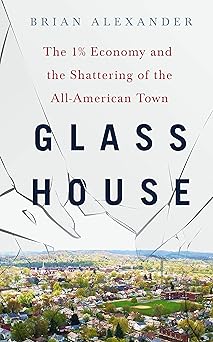 This book tells the story of Lancaster, Ohio’s sharp economic and social decline. Once hailed by Forbes in 1947 as the ideal “All-American town,” Lancaster’s identity revolved around Anchor Hocking Glass Company, a major glassware employer central to the town’s prosperity.
Starting in the 1980s, the company faced a series of leveraged buyouts and financial manipulations by private-equity owners. Cuts in investment in upkeep, as well as reduced jobs and wages, weakened the company’s future and the town’s economic foundation.
Alexander weaves this corporate unraveling with personal stories of workers, union members, local leaders and lifelong residents — revealing how, as Anchor Hocking’s fortunes eroded, so did Lancaster’s sense of self, stability and community spirit.
Ultimately, the book presents Lancaster not as an isolated case, but as a representative example of America's wider struggles — deindustrialization, the decline of manufacturing towns, growing inequality and fading communal bonds.
Excerpt: Corporate elites said they needed free-trade agreements, so they got them. Manufacturers said they needed tax breaks and public-money incentives in order to keep their plants operating in the United States, so they got them. Banks and financiers needed looser regulations, so they got them. Employers said they needed weaker unions — or no unions at all — so they got them. Private equity firms said they needed carried interest and secrecy, so they got them. … What did Lancaster and a hundred other towns like it get? Job losses, slashed wages, poor civic leadership, social dysfunction, drugs.
Chip War: The Fight for the World’s Most Critical Technology
Chris Miller
Released in 2022; 464 pages
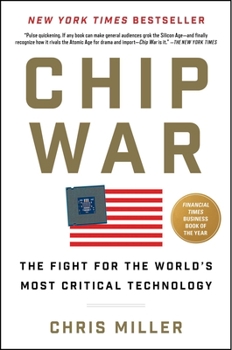 Miller has received high praise for his sweeping account of how semiconductors became the engine of modern life and a central battleground in geopolitics.
He traces the technology from the invention of the transistor and early integrated circuits, through the birth of Silicon Valley, to today’s globalized supply chains. A technology neophyte, I sometimes found it hard to picture each iteration of chip as Miller described it. But his detailing of each fulfillment of “Moore’s law” and semiconductors getting more powerful as they get smaller is a fascinating journey.
Over the decades, Miller argues, chips have become the “new oil,” powering everything from smartphones and cars to electric grids, missiles and satellites — meaning control over chip technology now underpins economic strength and military power. Hence, the war over it.
Manufacturing has shifted to East Asia, resulting in strategic chokepoints. Miller highlights Taiwan Semiconductor Manufacturing Company (TSMC) as critical because it produces much of the world’s most advanced chips — turning Taiwan into a linchpin of the global supply chain. Also, China is investing heavily to build its own chip industry and reduce dependence on U.S.-led supply networks.
Chip War argues that semiconductors have reshaped not only technology and commerce, but also global power and geopolitics. And whoever controls chip production and innovation may determine the balance of economic and military influence in the 21st century.
Excerpt: In polite company in Washington and Silicon Valley, it was easier simply to repeat words like multilateralism, globalization, and innovation, concepts that were too vacuous to offend anyone in a position of power. The chip industry itself — deeply fearful of angering China or TSMC — put its considerable lobbying resources behind repeating false platitudes about how “global” the industry had become. … So Washington kept telling itself that the U.S. was running faster, blindly ignoring the deterioration in the U.S. position, the rise in China’s capabilities, and the staggering reliance on Taiwan and South Korea, which grew more conspicuous every year.
The Great Escape: A True Story of Forced Labor
and Immigrant Dreams in America
Saket Soni
Released in 2023; 368 pages
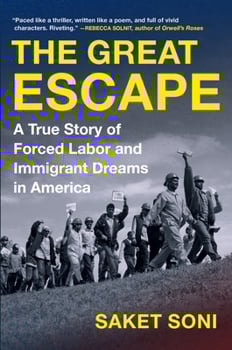 In recounting the shocking case of about 500 Indian migrant workers who were enticed to the U.S. after being promised well-paid jobs on Gulf Coast oil rigs and the prospect of green cards, Saket Soni is not only the reporter, but he is also a protagonist.
An Indian-born community and labor organizer, Soni took up the workers’ cause in 2006 after learning they paid up to US$20,000 each — often mortgaging their homes and taking on heavy debt — only to end up in “man camps,” crowded trailers surrounded by barbed wire, with rotten food and squalid living conditions.
Their visas were tied to a single employer, leaving them trapped in debt and effectively unable to leave, which Soni and others considered forced labor or human trafficking. With Soni’s help, the workers organized a daring escape, culminating in a march on foot to Washington, D.C., followed by a hunger strike to demand justice and a path to citizenship.
In the process, Soni struggles to keep many of the workers resolute and unified, and his relationships with some deteriorate — irreparably, in one case. He documents not just reckless corporate and recruiter exploitation, but also the systemic failures to prevent it.
Excerpt: So eighteen months from the day the workers arrived in Mississippi, everyone would find out what Malvern (Burnett, a New Orleans-based immigration attorney) already knew: H-2B visas, by law, could never turn into green cards. The workers would have to return to India even to apply for them.
The Gales of November: The Untold Story of the Edmund Fitzgerald
John U. Bacon
Released in 2025; 464 pages
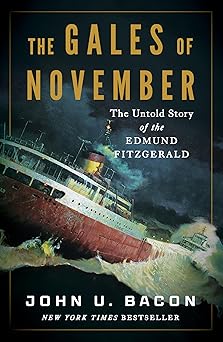 This book was a great resource for an Inside Supply Management® Weekly article I wrote about the Edmund Fitzgerald, the 729-foot Great Lakes ore carrier that went down on November 10, 1975, in a massive Lake Superior storm.
The Gales of November is a sweeping, deeply human retelling of the tragic sinking, as Bacon draws on more than 100 interviews among the tight-knit Great Lakes shipping community — family members, friends and colleagues — to bring faces and life stories to the 29 crew members, from seasoned officers and crew to young deckhands, who perished.
He also explores the history and broader context of Great Lakes shipping, including the iron-ore trade, taconite freight industry and the economic infrastructure that underpinned the region’s mid-century prosperity. Amid the lengthy storytelling and context setting, details of the actual voyage and sinking occur later in the book — and take fewer pages — than I expected.
That’s mainly because much remains unknown about what happened to the Fitzgerald. The details Bacon does present are thorough, based on technical and environmental analyses — including shoal navigation, hull design, radar failures and the “storm of the century” that few saw coming — to piece together possibilities.
“If there’s any consolation here, it’s that the end probably happened very quickly,” Matthew Collette, professor of naval architecture and marine engineering at the University of Michigan in Ann Arbor, Michigan, told Bacon. (The Fitzgerald did not send a distress call.)
There is even a chapter on how Gordon Lightfoot’s haunting 1976 ballad “The Wreck of the Edmund Fitzgerald” — with its lyric that inspired the title of the book — came together, making The Gales of November not only a broad history of a legendary vessel, but also a deeply personal tribute to the crew members and those they left behind.
Excerpt: Like with so many questions the Edmund Fitzgerald raises, we will never know the answers to those, either. Aunt Ruth (Hudson, the mother of a deckhand) herself said it best when she observed, “Only thirty know what happened: twenty-nine men, and God.” But they’re not talking, so the rest of us are just guessing.
(Top photo credit: Getty Images/Imgorthand)