
The End of the Throwaway Supply Chain
Circular models that prioritize repair, reuse and material recovery are moving from sustainability experiment to operational necessity as companies confront resource risk and new global regulations.

In many supply chains, the story of a product effectively ends when it leaves the warehouse. Organizations invest enormous effort to plan, source, make and deliver.
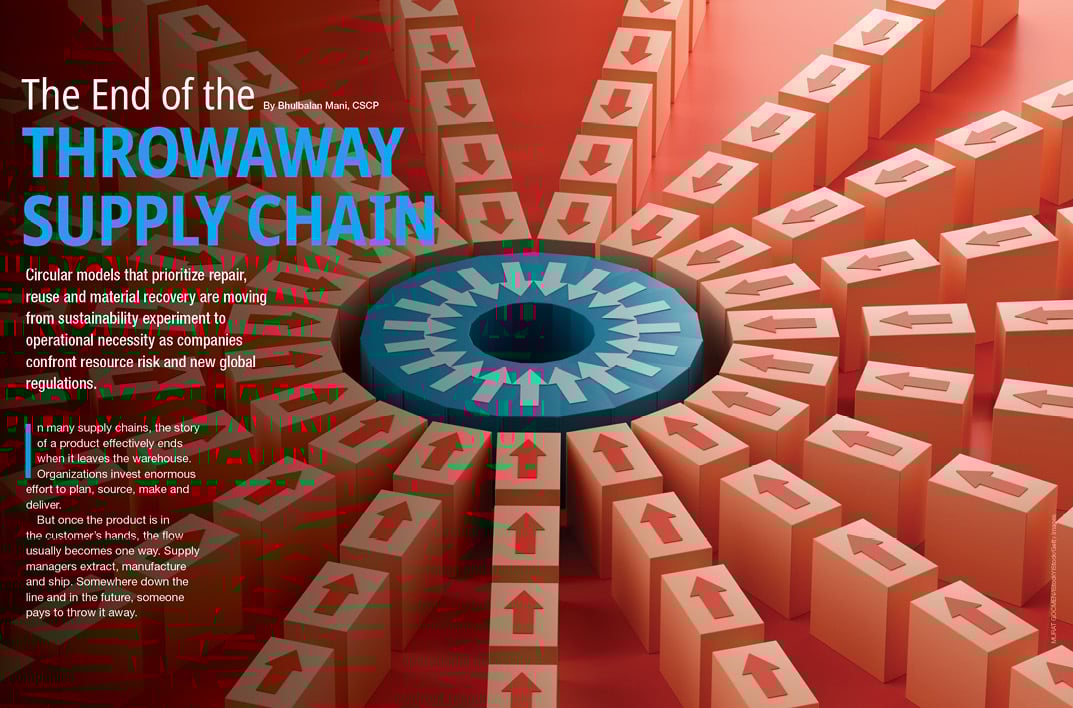
But once the product is in the customer’s hands, the flow usually becomes one way. Supply managers extract, manufacture and ship. Somewhere down the line and in the future, someone pays to throw it away.
That linear “take‑make‑dispose” model has had a long run. It worked when materials were relatively cheap, environmental externalities were ignored and regulations were light. But with rising resource volatility, tightening regulations and increasing stakeholder expectations, this model is silently accumulating risks and costs across the supply chain.
The transition to circular, regenerative models is no longer a theoretical sustainability topic. It is slowly becoming a core supply chain necessity.
The problem is not just about waste at the end of life. It is about how fragile value chains become when (1) materials are considered disposable and (2) the second and third lives of products are ignored.
The key reasons linear supply chains no longer make sense:
Resource and cost volatility. Critical raw materials for batteries, electronics and advanced manufacturing are concentrated in a few regions and subject to geopolitical risk. Depending only on virgin inputs leaves supply chains exposed to sudden price spikes and disruption.
Regulatory pressure. The European Union’s (EU) emerging circular economy framework — including the proposed Circular Economy Act, Packaging and Packaging Waste Regulation, and Batteries Regulation — is pushing durability, reparability, recycled content and producer take‑back obligations into product and network design. Extended producer responsibility (EPR) regulations for electronics, packaging and vehicles are expanding globally, especially in North America.
Market expectations and opportunity. The circular economy market itself is not a niche. DataM Intelligence, an India-based market researcher, projects it to grow from roughly US$638.6 billion in 2024 to around $2.2 trillion by 2034. Circular economy solutions (services, technologies and systems) are expected to reach about $5.8 trillion by 2034, up from about $2.9 trillion in 2025, according to Selbyville, Delaware-based Global Market Insights.
From a practitioner’s perspective, this changes the question from “Should we explore circular models?” to “Where in our supply chain does circularity reduce risk, recover value and improve resilience?”
A Circular, Regenerative Supply Chain
A circular supply chain is not a single project or a logo on packaging. It is a set of interconnected capabilities that keep products, components and materials circulating at their highest possible value for as long as possible.
Four building blocks repeatedly show up in companies making meaningful progress:
- Product life-cycle management (PLM) that explicitly designs for multiple lives instead of a single use
- Reverse logistics capabilities that are engineered, not improvised
- Material recovery and secondary markets integrated into sourcing
- Data and digital infrastructure that offers visibility into forward and reverse flows.
In a linear supply chain, the mental model is: “How do I move this product from Point A to Point B as efficiently as possible?” In a circular supply chain, the mental model becomes: “How do I maximize the value extracted from this product and its materials across time, including the loops back into my network?”
Where Circularity Really Starts
In putting together a warehouse automation project, I realized how much the outcome depended on how well my team and I defined constraints and actions upfront. Working with the wrong assumptions means fighting them throughout execution. The same applies to circular supply chains.
If we design products that are glued, welded and mixed with problematic substances, we are essentially deciding against efficient repair, remanufacturing and recycling. On the other hand, if at design time we decide that (1) modules should be replaceable, (2) materials should be chosen with recyclability and toxicity in mind and (3) components should be standardized across families, then we create “hooks” that future loops can latch onto.
The upcoming EU Ecodesign for Sustainable Products rules and product‑specific regulations will explicitly demand durability, reparability and minimum levels of recycled content in certain sectors, as well as digital product passports. That means PLM, engineering, sourcing, compliance and reverse logistics teams can no longer operate as separate silos.
From a supply management standpoint, practical implications include:
- Asking suppliers for material composition data and recyclability information as part of the RFQ process
- Including reparability, modularity and disassembly time as non‑negotiable design requirements
- Planning for second‑life use cases (for example, components designed for reuse in remanufactured units).
The quality of circular outcomes later is heavily determined by the quality of design decisions now.
From Cost Center to Value Engine
Reverse logistics is often where circular aspirations collide with operational reality. Historically, this function was treated as a necessary inconvenience to handle returns, warranty claims and recalls. Processes were fragmented by channel and rarely optimized end‑to‑end.
For circular leaders, the pattern almost always differs. Reverse logistics is designed as a core supply chain flow with a clear objective, recovering maximum value at minimum cost and risk.
Industry data suggests that companies with optimized reverse logistics can recover up to 65 percent of the original value of returned items. Instead of paying to store and dispose, they recover value through reuse, repair, refurbishment, secondary market sales and material recovery.
Patagonia’s Worn Wear Program
Patagonia has used circular principles to redesign part of its supply chain. The outdoor clothing and gear company operates in an industry that is notoriously resource‑intensive and wasteful. Instead of treating that as unavoidable, the company has steadily built circular practices into product design as well as downstream operations.
One of the most visible pillars is the Worn Wear program, where customers are encouraged to return used gear for repair, resale or recycling. They receive store credit for eligible items, which are then inspected, repaired where feasible, and either resold as “worn wear” or harvested for materials. Irreparable items are sent into material recycling streams for recovery of fibers and components.
The supply chain aspects of this model that stand out:
- The program depends on a structured reverse logistics flow. Products are consolidated, inspected and triaged into multiple disposition pathways (repair, resale and material recovery) rather than a single “returns” bucket.
- Product design choices support circularity. Patagonia uses high‑quality, durable materials such as recycled polyester and organic cotton, and it designs garments that can withstand repeated repair cycles.
- Data and transparency are built in. Patagonia’s broader strategy includes tracking life-cycle impacts, developing digital product passport‑like capabilities and using that data to inform sourcing and design decisions.
In 2025, Patagonia’s goal was to have all products made from recycled or renewable materials. The company also channels 1 percent of sales to environmental organizations, tying its commercial success to broader ecosystem health.
From a supply management standpoint, Worn Wear and the broader circular strategy provide such lessons as:
- Carefully designed take‑back programs and reverse logistics can support new revenue streams (like resale), reduce raw material demand and improve brand equity
- Working closely with suppliers on recycled inputs and repairable designs enables more efficient downstream operations and higher recovery rates
- Data on failure modes, repair rates and return patterns can be fed back into design and sourcing, closing the loop and gradually improving both product and process.
The principles of Patagonia’s program — design for repair, structured take‑back, integrated reverse logistics and data‑driven improvement — translate well into electronics, industrial equipment and other sectors.
Material Recovery, Recycling and Sourcing
When reuse or refurbishment aren’t feasible, the focus switches to recovering material value. This is where regulatory and market signals are especially strong.
The EU’s Critical Raw Materials Act has a 2030 target of reaching at least 25 percent of the union’s strategic raw material demand from recycling. Packaging, batteries and vehicle regulations are tightening minimum recycled content thresholds and restricting landfilling and incineration.
At the same time, markets for secondary materials are growing. The plastic recycling market, for instance, is projected to expand significantly in the next few years as packaging and consumer goods companies commit to higher recycled content in their products.
This changes how procurement and supply management professionals think about suppliers: Recyclers, remanufacturers and material recovery facilities become strategic partners.
Practical steps include (1) signing off‑take agreements for key waste streams to ensure stable outlets and pricing, (2) working with suppliers to align specifications so recycled inputs can meet performance requirements and (3) incorporating recycled content and material circularity as evaluation criteria in sourcing decisions.
Achieving these steps will extend the supply base to include providers and suppliers that feed recovered materials back into production.
Data And Digital Infrastructure
Working on data processing projects, I learned that without a solid foundation for capture, storage, processing and analysis, it is almost impossible to derive meaningful insights from large, complex data sets. Circular supply chains face a similar challenge.
In deciding on whether to repair, refurbish, remanufacture or recycle, it’s imperative to have reliable data, including:
- Product identity and configuration (serial numbers, variants and material composition)
- Usage and maintenance history, where available
- Return reasons and condition at the point of receipt
- Regulatory requirements and geographical constraints.
Digital product passports, Internet of Things (IoT) sensors, integrated PLM, warehouse and transportation management systems, ERP and serialization make up the backbone of visibility. Once these assets are in place, advanced analytics and AI can help:
- Predict return volumes by product and region
- Recommend optimal disposition paths — for example, which items go to repair versus direct reuse or parts harvesting
- Identify failure patterns and design weaknesses, then feed them back into engineering and sourcing.
This is similar to how hot-spot analysis helps isolate critical zones in a spatial data set. In a circular supply chain, the goal is to identify where value is concentrated and where it is leaking — across space, time and product type — then design interventions to address those hot spots.
The Regulatory Landscape
Circular initiatives started as voluntary corporate programs, but that era is quickly fading. The emerging regulatory architecture is turning circularity into a license‑to‑operate issue, especially in heavily regulated sectors.
Supply management professionals must monitor:
- Product‑specific rules that affect design and materials — for example, recycled content requirements in batteries and packaging, reparability scores for electronics
- EPR schemes that shift more end‑of‑life obligation and cost from municipalities to producers, with binding collection and recycling targets
- Digital transparency mandates like product and battery passports, which require standardized data collection and sharing across the chain.
For global companies, the practical challenges are designing supply chains to meet the strictest applicable requirements and managing variations in implementation across regions. From an operational standpoint, it is often safer and simpler to adopt a higher internal standard and localize documentation and labelling, rather than trying to maintain separate product and process designs.
A Broader Importance
Circular supply chains also have clear national and strategic implications. Many governments are starting to treat circularity as critical element of their industrial policy and resource security.
By recovering more materials domestically, countries can reduce dependence on imports of critical raw materials and mitigate disruption exposure. Investment in repair, remanufacturing, recycling and associated digital infrastructure creates local jobs and capabilities that support broader manufacturing ecosystems.
In addition, circular practices help countries meet climate and environmental targets by (1) reducing upstream emissions from extraction and processing and (2) lowering levels of waste heading to landfills and incinerators.
For supply management leaders, this means circular supply chains are increasingly intertwined with national priorities around resilience, competitiveness and sustainability. Decisions made on design, sourcing and network configuration have implications beyond individual companies.
How The Future Might Evolve
Based on current trends, circular supply chains move through three overlapping phases. Different industries and regions will progress at different speeds, but the steps are similar:
1) Compliance‑driven adaptation. Focus on meeting new regulations by adjusting design, labelling, reporting and end‑of‑life processes. Reverse logistics becomes more structured, primarily to satisfy take‑back and recycling obligations.
2) Data‑driven optimization. As digital product passports, IoT and analytics mature, companies start optimizing where and how to perform repair, refurbishment, remanufacturing and recycling based on real data. Circular flows are integrated into core processes like sales and operations planning, network design and capacity planning.
3) Platform‑based ecosystems. Sector or regional platforms emerge for shared repair networks, refurbishment centers and material exchanges. Business models shift further toward product‑as‑a‑service and long‑term asset management, where a physical product remains under the manufacturer’s ownership and the supply chain is responsible for performance across multiple life cycles.
This is similar to how we move from ad‑hoc scripts to full‑fledged platforms in data processing — initial compliance, followed by performance optimization and then ecosystem‑level collaboration.
Recommendations
Transforming into a circular supply chain requires strategic as well as tactical moves. Among the steps that supply management and operations leaders can consider:
Identify high‑potential product families. Start with products that have high material value, high return or failure rates, or strong regulatory pressure. Map current end‑of‑life flows: where a product goes, who touches it and where value is lost.
Embed circular requirements in design and sourcing. Include criteria like reparability, modularity, disassembly time and material recyclability in design gates and RFQs. Work with strategic suppliers on standardized components and materials to simplify downstream repair and recovery.
Treat reverse logistics as a core network. Define a standard end‑to‑end process for returns — from customer authorization to collection, consolidation, inspection, decision and final disposition. Consider regional hubs for inspection, triage and first‑level repair or refurbishment. Determine elements to build in‑house and where third‑party specialists or 3PL providers can aggregate flows and provide capabilities.
Build the data spine. Start with serialization and basic return data capture (reason codes and condition) and then progressively add richer information like component‑level failure data and repair history. Align internal data standards with emerging digital product passport requirements to avoid redesigning systems later.
Redefine success metrics. In addition to cost, service and inventory, track the (1) percentage of revenue from refurbished or remanufactured products, (2) percentage of materials sourced from secondary streams and (3) recovery rates and waste diversion at end of life. Use these metrics to drive continuous improvement and to build the business case for further investment.
Embedding a Circular Approach
Circular supply chains are no longer a nice‑to‑have experiment. They are becoming — albeit gradually — part of the core operating model for supply chain organizations to stay resilient, compliant and competitive.
The good news is that creating a circular supply chain doesn’t require an immediate reinvention. It starts with a few deliberate choices: picking the right product families, designing with the second life in mind, treating reverse logistics as a value stream, and building the data backbone one step at a time.
If organizations can achieve those objectives, we move from talking about “preserving the planet” in abstract terms to redesigning the flows we control — materials, products and information — in a way that regenerates value instead of leaking it. That is where supply management can make a meaningful difference.
Photo credit:MURAT GOCMEN/iStockYiStock/Getty Images