
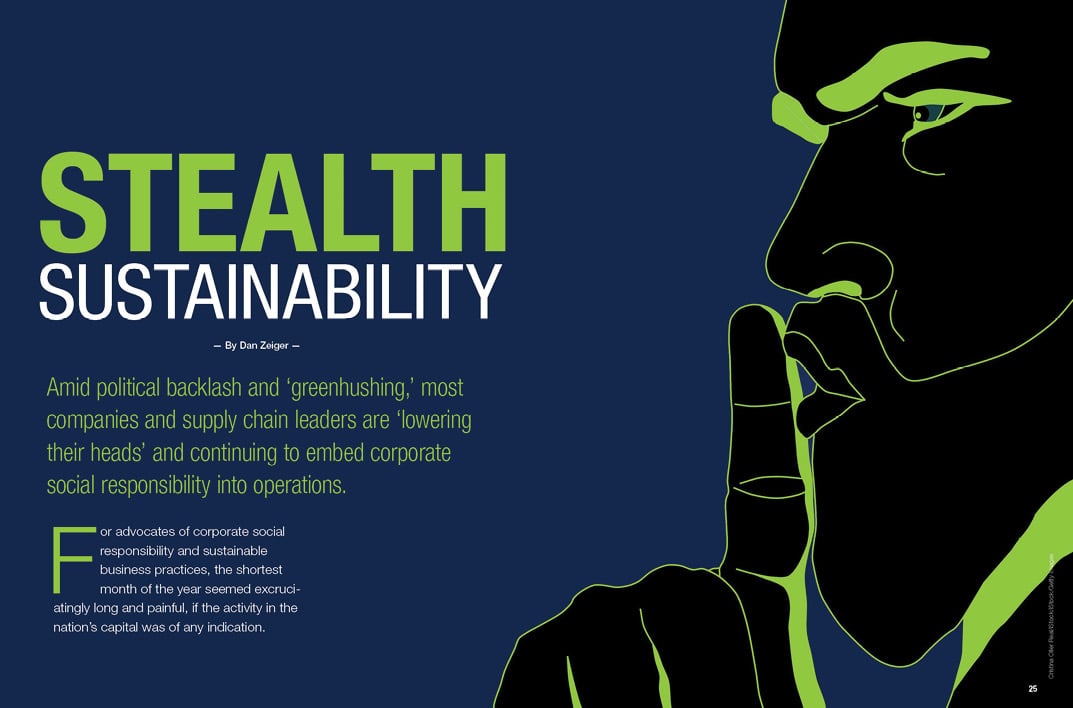
Stealth Sustainability
Amid political backlash and ‘greenhushing,’ most companies and supply chain leaders are ‘lowering their heads’ and continuing to embed corporate social responsibility into operations.

For advocates of corporate social responsibility and sustainable business practices, the shortest month of the year seemed excruciatingly long and painful, if the activity in the nation’s capital was of any indication.
In mid-February, President Donald Trump, who routinely calls climate change a “hoax,” announced a full repeal of the U.S. Environmental Protection Agency’s (EPA) “endangerment finding,” which helps provide the basis for federal enforcement of greenhouse-gas (GHG) emissions under the Clean Air Act. Though public-health and environmental organizations swiftly responded with a legal challenge, the repeal was the latest strike against such protections over the president’s two terms
Two weeks later, at the State of the Union address, Trump declared, “We ended DEI in America,” referring to diversity, equity and inclusion initiatives. On the surface, corporate sustainability efforts appeared under continuing assault, leading a prominent climate skeptic to tell The New York Times, “We are pretty close to total victory.”
So, where does that leave companies and supply chain organizations? Many are not popping champagne corks over the increased laissez-faire environment but remain committed to sustainability — whether out of principle, in response to investor and consumer sentiment, or to comply with regulations outside the U.S. that remain more stringent.
The current environment demands a “delicate balance,” says Cathy Rodgers, a retired sales and supply chain executive at IBM and former Chair of the Institute for Supply Management® (ISM®) Sustainability, Social Responsibility and Ethics Committee.
“The global supply chain is so interconnected, more so now than ever before,” she says. “Investors, customers, suppliers — everyone — has expectations, and those expectations often influence a company’s programs and public responses. Do some companies fail to do the right things for the right reasons, yet not lose sleep over it? Probably, but that does not represent the vast majority.”
While companies are continuing to pursue sustainability and corporate social responsibility (CSR), many have chosen not to promote it amid political headwinds, regulatory complexity and competitive pressure. The popular name for this action — greenhushing — can imply unethical motives, but some organizations have legitimate reasons for keeping on the down low.
And in some cases, silence helps aid success, suggesting that “stealth sustainability” might be a more appropriate term.
“When it comes to sustainability, companies and people are lowering their heads and spending less time on marketing and communication,” Rodgers says, “and more time quietly looking at their programs and still investing for the long haul.”
A Change in Volume
For much of the past decade, corporate sustainability was loud.
Companies published glossy reports, pledged ambitious climate goals and filled conference stages with talk of environmental, social and governance (ESG) commitments. Sustainable or ESG funds were hot investments. Supply management leaders whose profiles raised during the coronavirus pandemic were even more valued, explaining how procurement strategies and logistics efficiencies were helping save the planet — and the bottom line.
Sustainability, it was often said, is smart business. Then came the political and legal backlash in the U.S., exemplified in the February setbacks in Washington. Russia’s invasion of Ukraine in 2022, in some corners, put energy security concerns above the climate. And ESG investing slowed, in part due to some U.S. states restricting use of public funds.
“In a democratic society, we fight some things out on a cyclical basis, especially every four years in the U.S., to determine what’s most important,” says Regina Heyward, J.D., senior vice president for economic opportunity for the Civic Committee of the Commercial Club of Chicago. “In the sustainability space, we are in one of those intense cycles right now.”
In perhaps an indication of the current environment, multiple company supply chain leaders and practitioners politely declined to comment for this story. According to those who did speak with Inside Supply Management®, the reality is more nuanced.
To some critics, the quieter tone signals retreat. To others, it reflects a mature discipline recalibration.
“There are situations in which a company does not communicate its sustainability practices, and it doesn’t have anything to do with intent,” says Kevin Dooley, Ph.D., professor of supply chain management at the W. P. Carey School of Business at Arizona State University in Tempe, Arizona. “It has to do with just the nature of companies, especially big companies.”
Not All Silence Is Strategic
There are three key reasons, Dooley says, that sustainability silence is not so much deliberate concealment out of political fear, but rather a product of organizational dynamics.
First, companies may be doing sustainability work without labeling it as such. Logistics teams redesigning distribution networks to reduce empty backhauls are cutting emissions — but the primary focus might be on fuel savings and cost efficiency. Procurement teams reducing waste or water usage in supplier facilities may see it as operational excellence rather than climate action.
“They don’t necessarily know to tell that to the people writing their CSR report, and the report writers don’t know to find out what they’re doing and instead tell the logistics story,” he says. “So, a company may be undertaking all sorts of actions that I as a professor or sustainability consultant would say, ‘Great job; you’re doing exactly the right thing.’ But they don’t attach it to sustainability.”
Second, disclosure is selective by necessity. Multinational corporations like Walmart and Procter & Gamble operate sprawling global supply networks and multiple sustainability initiatives at once. Corporate responsibility reports are finite documents: “They have to be selective in the story they tell,” Dooley says. “There’s no room to tell everything.”
The third category is more intentional. On certain issues, companies may avoid being perceived as industry leaders to reduce legal exposure or activist scrutiny, he says. In competitive sectors, sustainability innovations can also be valuable intellectual property.
“On issues not considered of business strategic value, companies may not want to lead publicly,” says Dooley, who is also chief scientist at The Sustainability Consortium, an Arizona-based nonprofit organization focused on the use of more sustainable consumer products.
In that sense, greenhushing could reflect sustainability’s evolution from collaborative pursuit into a source of competitive advantage, or at least differentiation. Rodgers describes the shift through what she calls the “four Ps” — planet, people, profit and policy.
“Companies that embed sustainability into their business models,” she says, “see cascading competitive benefits: better resilience, better adaptability, stronger bottom lines.”
However, the tension between collective progress and competitive secrecy is reshaping disclosure practices, Rodgers says: “In the early days, leaders shared best practices to advance the field. Now, sustainability is absolutely a strategic differentiator.”
Political Headwinds, Operational Continuity
In the U.S., sustainability has become entangled in partisan debate. Executive orders and public rhetoric have prompted some companies to reassess language around climate and ESG disclosures. But on the ground, supply chain due diligence appears to be continuing.
“We haven’t seen any backpedaling in our customer base or lost a single company because it stopped doing (sustainability) programs due to backlash,” says Jon Hancock, CEO of Sedex, a London-headquartered global organization that specializes in the human rights space, providing supply chain data, a sharing platform and a third party-conducted audit standard.
According to a 2025 study by the United Nations (U.N.) Global Compact and Accenture, a global professional services company, 99 percent of surveyed CEOs are “staying the course” on their companies’ sustainability commitments. A Deloitte survey last year found that climate change and sustainability was the “most pressing” challenge at respondents’ organizations, with 83 percent reporting an increase in investment to address it.
“There’s a lot of lip service to ESG backlash, but the reality is organizations are not backing away from their investments,” Hancock says. “In fact, I would argue that many of them are going further into understanding (the impact on) supply chains.”
More than 65,000 supply chain human rights reviews were performed by Sedex’s audit affiliates last year — a “mind-blowing scale,” Hancock says. Many of those issues involve labor standards, workplace safety and due diligence beyond Tier-1 suppliers. Such regulations as the Uyghur Forced Labor Prevention Act continue to result in shipment scrutiny at U.S. ports of entry, while European directives are expanding human rights and environmental reporting obligations.
“The rhetoric may shift,” Hancock says, “but nobody’s repealed those laws.”
Heyward, a former supply chain executive at health-care, manufacturing and financial services companies, says sustainability performance and risk mitigation remain business imperatives.
“Boards of directors still have a fundamental responsibility to ensure organizations are well governed, that risks are identified and managed,” Heyward said. “What I’m seeing is more scrutiny, more board-level visibility and a stronger risk lens — not a wholesale pullback.”
Heyward describes the current environment as a cyclical recalibration. In her view, sustainability moved through a period of heightened visibility and inflated expectations. Now, companies are assessing execution strategies more carefully.
“Around 2020, political dynamics around climate and social issues created lightning-rod moments,” she says. “As a result, organizations started asking practical questions — why, how, who and long-term impact — and we’re flowing through that cycle now with more enlightened perspectives. That doesn’t mean the work stops.”
She continues, “We continue making progress, but after inflated hype, we’re normalizing and clarifying what the future should look like.” Until companies clarify their sustainability efforts, many are hesitant to disclose them.
The Risks of Quiet
This dynamic raises an obvious question: If sustainability initiatives continue to be pursued and investments are still made, who is hurt if companies keep secrets? However, there is a risk that silence can turn into avoidance.
Dooley argues that reduced disclosure can slow cross-industry learning and internal engagement.
“There’s value in collaboration,” he says. “When companies talk publicly about what they’re doing, others can learn from it. And internally, employees often don’t even know the scope of sustainability efforts until they see it in a report. When they read it, they’re shocked by how much good work is happening. Even if companies publicly disclose less, they should still tell that story internally.”
Cross-organizational learning is especially crucial in the human rights arena, where such systemic issues as living wages, forced labor or migrant worker recruitment fees cannot be solved by individual companies acting alone, Hancock says. They require collective action and shared standards.
While executives and practitioners continue to discuss those issues at U.N. and Organization for Economic Cooperation and Development forums, Hancock says, less public dialogue could dampen momentum.
“Perhaps forced labor in supply chains, for example, won’t get addressed in the same way if people aren’t talking about it as much,” he says. “There’s a bit less public learning and awareness, and that’s not good in the long term.”
Rodgers says silence, if it becomes permanent, creates reputational risk.
“You can only lower your head for so long without diluting your brand and market position,” she says.
“Buying time and not blowing your horn allows companies to conduct internal operations more effectively, efficiently and quickly, to try new things, see what works, and generate intended outcomes. However, markets demand consistency and accountability, and silence eventually becomes suspicious.”
Sustainability as a Strategy, Not a Slogan
For supply management leaders, the question is less about marketing and more about integration. Sustainability initiatives are tightly aligned with overall business objectives — “planet equals profit” is simply required arithmetic, not matter how much sustainability skeptics want to throw out the textbook.
COVID-19 exposed the fragility of global supply chains, reinforcing the importance of resilience, redundancy and multitier supplier visibility, which happen to be core components of modern sustainability programs.
Among the items in procurement’s sustainability tool kit:
Start with business strategy. “Understand your organization’s short- and long-term objectives, because that drives C-suite and board decisions,” Heyward says. “Be able to present options and outcomes. Data and insights are critical.”
Use technology judiciously. Advances in analytics and AI allow companies to model climate risk, predict supplier disruptions and assess long-term exposure.
However, “there are AI tools that claim to know everything about human rights risk,” Hancock warns. “If they don’t have primary, site-level data, they won’t stand up over time.”
Third-party verification remains central. Standardized audits help validate supplier performance beyond self-reporting.
Contracts are critical. While not every supplier agreement includes detailed sustainability clauses, material risks tied to safety, compliance or consumer harm must be addressed formally.
“Anything tied to regulatory exposure or reputational harm should be embedded in contracts,” Heyward says. “Other expectations may rely on relationship strength and market influence.”
Stealth, Not Surrender
In the near-term, companies figure to keep their heads down. But while it was a frantic February for sustainability regulations in America, disclosure legislation marches on globally.
The European Union (EU) has relaxed sustainability reporting requirements in hopes of boosting business competitiveness, but some policymakers expressed desire to revisit the changes, questioning whether decreased transparency is worth projected annual economic growth of less than 1 percent of EU gross domestic product.
And California lawmakers remain determined to enact climate reporting rules, though there is a legal challenge. Some level of sustainability disclosure is coming for companies who want to do business in these and other jurisdictions, and savvy consumers will know where to find the information.
“Accountability will return. Companies and suppliers know they’ll be asked to demonstrate performance,” Rodgers says. “There’s too much money and opportunity at stake.”
She continues, “Global standards haven’t changed just because the U.S. posture has shifted. The loudest voice isn’t always the one that sets the future playbook. Supply chain leaders need to play the long game.”
For supply management organizations, Heyward says, the path forward is clear: Focus on the fundamentals.
Know your supply chain beyond Tier-1. Invest in credible data and third-party verification. Integrate sustainability into risk management and operational strategy. Collaborate where necessary — and differentiate where appropriate.
“We’re still in that cycle,” Heyward says. “There was hype, conflict and clarification, which is where we are now. Many organizations are strategic and see long-term value. This is the time to listen to sustainability experts, invest in supply chains, engage third parties and create intentional plans for the future.”
Political and cultural cycles influence tone and terminology but can’t erase supply chain realities like regulatory requirements, investor scrutiny, consumer expectations and operational risk. Greenhushing is the term for the moment, but stealth sustainability could be a better definition of the strategy.
The decisive factor, Dooley says, is whether sustainability and diversity are embedded deeply enough that it no longer depends on what labels or acronyms companies use — or how loudly they talk about them.
“If it’s cooked into the culture,” he says, “you’re not shaking it out.”