
In Freight and Logistics, Data Makes You Dangerous

“It is a capital mistake to theorize before one has data. Insensibly one begins to twist facts to suit theories, instead of theories to suit facts.” — Sir Arthur Conan Doyle in Sherlock Holmes: A Scandal in Bohemia (1891)
***
More than almost any other business function, logistics is a numbers game.
Whereas marketing and management and even finance might ponder psychology and a business’s human element, logistics is concerned primarily with the movement and the storage of physical, tangible things.
How many items are in inventory at this location? At what rate are our items flying off the shelves? How quickly can vendors half a world away replenish our factories and our storefronts? The business of logistics is, above all, countable and measurable.
Of course, this imminent numeracy is not necessarily all good news — parlor tricks and carnival attractions can be numbers games, too. And, as every gambler knows, only the house reliably wins. To play and win, you need an edge. You need insight. As the great Sherlock Holmes advised Dr. Watson in 1891, you need data.
Information is the Currency of Democracy
Luckily, we all live in a time and place where most modern economies recognize the importance of independently collected, curated and disseminated economic data.
The importance of open-access government statistics has been codified at the international level by both the United Nations Fundamental Principles of Open Statistics (1994) and the International Monetary Fund’s Special Data Dissemination Standard (1996). In effect, governments have recognized the value in providing citizens with access to reliable and timely information about economic performance.
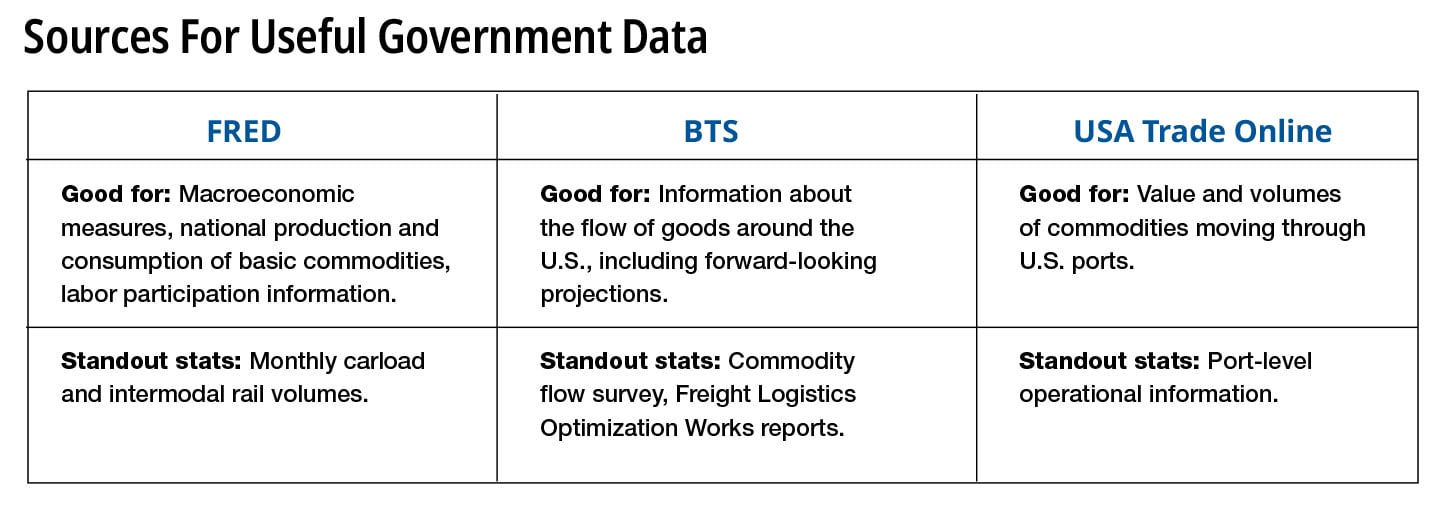
So, the first place to look for helpful data is your country’s federal government. In the U.S., three sources stand out: (1) The Federal Reserve of St. Louis’s Federal Reserve Economic Data (FRED) system, (2) the U.S. Department of Transportation’s Bureau of Transportation Statistics and (3) the U.S. Census Bureau’s USA Trade Online database. Key sets of logistics-relevant data available from each are shown below.
What Gets Measured Gets Managed
Of course, these government statistics are aggregate measures. But you are accountable for your company’s numbers. How will you source that data?
In logistics, this is actually more of a challenge than most people realize. Particularly regarding in-transit inventory, it is difficult to pinpoint at any moment in time where inventory is en route and when it should arrive. For this, your company will likely need specialist data partners who can help you to track, measure and manage your company’s in-transit freight.
Intermodal specialists like project44, FourKites and Descartes build relationships with carriers and makers of the GPS-enabled telematics technologies that track freight trucks and cargo vessels.
In essence, they offer software-as-a-service (SAAS) access to the real-time geoposition of cargo on a world map. Depending on the product and the package, leading companies in this space can also offer service alerts, information about commodity status and estimated time of arrival.
Modal specialists. However, not every freight shipment is best tracked outgate to ingate at the vessel level like trucks and cargo ships. In other contexts, modal specialists have developed dedicated technologies appropriate to specialized customer needs.
Vizion, for example, provides the ability to track one level deeper, at the individual shipping container level. Also in the maritime space, Windward offers sophisticated maritime fraud detection and sanctions exposure alert tools to protect in-transit cargo.
Railroads are a special case due to some of the important nuances of America’s freight rail system. First, unlike trucks and ships, freight trains are not (yet) required by law to be equipped with GPS-enabled telematics devices. Rather, train location is monitored by a bespoke RFID-tag based system called Automatic Equipment Identification (AEI).
Telegraph has developed systems to dashboard railcar geolocations and analyze AEI signals to estimated time of arrival. RailState’s nationwide system of trackside cameras help provide granular insights into American and Canadian rail freight movements, and Railpulse is developing the infrastructure to bring GPS-enabled telematics to rail traffic.
American railroading is a fascinating confluence, where Victorian-era industrial infrastructure meets today’s information technology systems.
What You Do With Data Really Counts
The government data described here can help you get a handle on the macroeconomic trends that influence your business’s logistical operating environment. A specialist SaaS supplier can help you to understand where your in-transit cargo and inventory positions are in real time, and across all modes of freight transportation.
But how do you actually win? What makes you dangerous? Three strategies stand out:
Transportation portfolio realignment. Anyone reading the macroeconomic trends has observed that trucking rates have been in the doldrums for four years.
Savvy transportation procurement professionals can use the data sources highlighted here (and others) to consider the cost benefit of their existing modal choice and carrier relationships. When market pricing favors one mode over another, they can reallocate transportation portfolios accordingly.
Data can also help you to understand which railroad services are performing slower or faster compared to long haul trucking in order to help you make the right modal choice for the moment.
Network redesign. Many American manufacturers source heavily from foreign suppliers, sometimes moving product back and forth across borders several times before reaching an end consumer.
As American tariff policies have evolved in fits and starts over the last year, some companies have reconsidered where they source from and how they import. Data-savvy importers and exporters can compare the total landed cost implications of changing both their international sourcing (from China to Vietnam, for example), as well as their port of entry/exit and domestic routings (say, from inbound via Los Angeles to inbound via Savannah, Georgia).
Intelligent automation. Any of the many logistical processes that can be digitized can, of course, also potentially be automated. This potential has grown exponentially with the widespread adoption of AI tools.
Consider exception handling. Imagine a world where you don’t have to keep a close eye on your in-transit cargo because the AI agent does that for you. The AI knows how to detect in-transit abnormalities, like divergence from expected travel path, or product-damaging changes in temperature. In today’s world, such crises would precipitate a fire drill for the receiving teams whose cargo does not arrive on time or in good condition
However, in an intelligent automated system, the AI puts this fire out for you. The AI agent that monitors your in-transit cargo for abnormalities has already directed another AI agent to rush-order replacement stock from a nearby vendor. Your systems stay up and running. No headaches. No fire drills.
***
Data makes you better informed. But it doesn’t, on its own, make you right about anything. The data is input. It is signal. Interpretation and action are up to you.
The opportunity, and the burdens that come with working in the imminently countable and measurable business of logistics, are yours, and yours alone. To think of it any other way would be “a capital mistake.”
Photo credit: style-photographyiStock/Getty Images Plus