
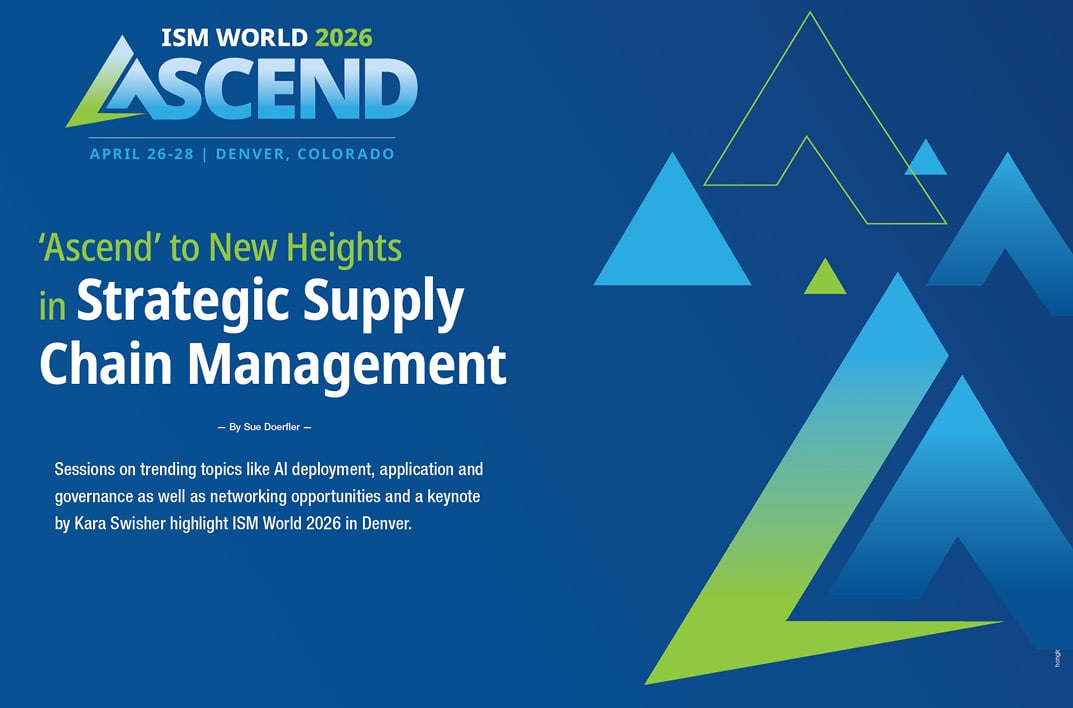
‘Ascend’ to New Heights in Strategic Supply Chain Management
Sessions on trending topics like AI deployment, application and governance as well as networking opportunities and a keynote by Kara Swisher highlight ISM World 2026 in Denver.

If you ask what the biggest game changer in supply management is — now and in the future — some might answer “the on-again, off again tariffs,” “the economy” or “uncertainty.” But more likely than not, the answer will be “AI.”
“It’s like a new frontier,” says Amanda Prochaska, founder and chief wonder officer at Wonder Services, a peer-to-peer consulting firm in Las Vegas. “There is a lot of exploring right now — and piloting and testing. And some organizations are diving in full on. AI really is a new era for supply chains.”
AI is one of the hot topics — and Prochaska one of the session presenters — at ISM World 2026, Institute for Supply Management®’s (ISM®) 110th Annual Conference, April 26-28 at the Gaylord Rockies Resort & Conference Center in Denver. With a theme of “Ascend,” the Conference features a variety of sessions on AI deployment, AI-powered cost-savings agents, talent and AI, making your procurement team AI ready, and more.
“AI isn’t just a matter of continuous improvement for supply management; it is a fundamental pivot,” says Debbie Fogel-Monnissen, interim ISM CEO. “We see the profession moving from reactive firefighting to a future defined by autonomous processes and predictive risk mitigation, which allows organizations to navigate complexity and prioritize strategy and value creation.”
The keynote speaker is a well-known authority on AI: Kara Swisher, The New York Times best-selling author, host of the “On with Kara Swisher” and “Pivot” podcasts, as well as co-founder of the technology website Recode and tech conference Code, will discuss the unprecedented speed of technological change, including AI. She will decode the real-world impact of generative AI on business strategy and the global supply chain.
AI won’t be the only topic discussed at the Conference; there are also sessions on transportation, negotiation, community sourcing, workplace culture, the semiconductor and automotive industries, leadership and other supply chain trends, issues and challenges. Other features include networking opportunities, the ISM Awards Gala, the ISM International Student Case Competition and the Expo, where attendees can learn about new products and solutions, join in interactive experiences at the Innovation Park, and more.
“In an era of rapid disruption, ISM World 2026 provides the insights and peer networks necessary to stay ahead,” Fogel-Monnissen says. “It’s where supply management leaders gather to master global trends, celebrate their peers and collective impact, and build the connections that drive career and organizational growth.”
AI Deployment
Procurement processes used to be paper-based until the digital transformation era moved everything online. The next transformation was the cloud, but AI is “a completely new ballgame,” Prochaska says. Not only does it require deployment, but it also involves training: You are building a new technology as well as training it to meet your needs.
At ISM World 2026, Prochaska will provide a roadmap for turning AI from concept to competitive advantage during her interactive session, “From Design to Delight: Mastering the Five Ds of AI Deployment.” They are:
- Discover. Identify the specific procurement challenges where AI can add the most value.
- Design. Map out the process flow and determine how the AI agent will interact with human teams.
- Develop. Build or configure the AI solution, focusing on training it to meet specific needs.
- Demonstrate. Test the deployment to ensure it works as intended while building team capabilities.
- Delight. Reach the final stage where the technology provides a seamless, high-value experience that improves results.
The Time Is Now
Historic game-changing technology deployments have taken months or years. AI is different. “The process of deploying an AI agent can take a matter of hours,” says Prochaska, who is presenting another session, “AI in Action: Practical Applications for Supply Chain Success,” with Elena Polansky, president of Somerset Solutions Advisory Partners, and Mukul Parkhe, continuous improvement manager at DHL Supply Chain. “It’s not like when I started in the industry, where one of my first projects was a five-year-long ERP deployment,” she adds.
The session will focus on agentic AI, particularly in the source through contract/negotiation space, Prochaska says: “How can we get greater intelligence than we’ve ever had before? There are technologies that will listen to your conversation as you’re negotiating with a supplier and give you intelligent prompts around how to negotiate more effectively. There also are AI agents that will negotiate on your behalf — and you’re not even involved until the outcome.”
There are AI intelligence platforms that can help with should-cost modeling, while other AI-driven solutions can perform all the various tasks that a sourcing manager needs to do to prepare for a negotiation, Prochaska says. “There are also AI agents that will help you schedule quarterly business reviews with your suppliers,” she says.
“What I like to think about is not necessarily the technology that’s available, but what is it going to do?”
The Talent Question
Two out of five (41 percent) of human resources leaders believe their workforce lacks critical skills, 50 percent say their organizations aren’t effectively leveraging existing skills, and 62 percent view uncertainty around future skills as a significant business risk, according to a June 2024 survey by Gartner, the Stamford, Connecticut-based business and technology insights company.
Meanwhile, the World Economic Forum’s Global Skills Taxonomy projects that nearly 39 percent of core skills will change by 2030.
That gap presents a clear opportunity for organizations, which will be discussed in a session presented by Allison Silveus, Ed.D., MS, supply chain training program manager, and Rebecca Johnson, CPSM, senior director — strategic sourcing at Intuitive, a global technology leader in robotic-assisted surgery and minimally invasive care.
By pairing human expertise with AI, organizations can rethink how capability building happens — using a mobile first, user centric learning model that’s adaptable, scalable and cost conscious across the global supply chain, Silveus says: “The goal isn’t to replace people, but to amplify them with AI tools — meeting learners where they are and enabling growth in the flow of work.”
Silveus and Johnson’s session, “Building the Next Generation of Talent for the Human-AI Era,” will delve into how organizations can reimagine global training through a mobile first, AI enabled approach. They will present a four step framework to scale learning, accelerate upskilling and future proof the workforce.
“We’ll showcase AI tools and digital content libraries that support localized customization before concluding with practical ways to activate leaders as job coaches to drive capability building at the point of work,” Silveus says.
Future ready skills require future ready learning — and the combination of AI and human insight is proving to be a powerful place to start so companies can grow their teams effectively, she says.
Adapting and Resilience
Deploying AI requires a paradigm shift in how organizations approach deployment, job roles and more.
Consider when society moved from the horse-drawn carriage to the Model T. Imagine how jobs changed: There was no longer a great need for farriers (or horseshoers), workers who cleaned streets of horse droppings and other equine-related positions. “But we adapted,” Prochaska says. “That’s what we’re really good at as human beings: We adapt, we progress forward and we find new paths forward.”
She continues: “There’s going to be a lot of adapting that’s happening. But you also learn new skill sets along the way.” A century ago, for example, workers adapted by learning to repair engines, pave roads and other new transportation-related skills. “There is to be a lot of opportunity with AI deployment for people to learn something new,” Prochaska says. “It’s daunting, but also very exciting at the same time.”
The speed of change associated with AI may perhaps be the most daunting aspect.
“It’s going to be one of those revolutions that happens much more quickly than anything else in our lives,” Prochaska says. “And one of the concerns — or maybe opportunities — is how do we as people keep up with that?”
New governance models will be needed, she says: “Existing governance models were built for the digital era, not for the AI era. How do we think about governance differently?”
In addition, organizations need to discard their fear of AI, she says, and be prepared to embrace the technology and the opportunities it brings.
Over the past few years, discussion centered around how AI would not upend jobs. “It might,” Prochaska says. “But the more real we can be around that, the more people we can take from being a horse trainer or a carriage driver to being the next race car driver. The more real we can be about it, the more we can prepare for it, the more we can be excited about it.”
She concludes, “It’s coming, whether we like it or not. But the more that we can be prepared, the better off we’re going to be.”
Photo Credit:honglouwawa/iStock/Getty Images