ISM®’s New CEO Leverages Leadership, Engagement and Transformation
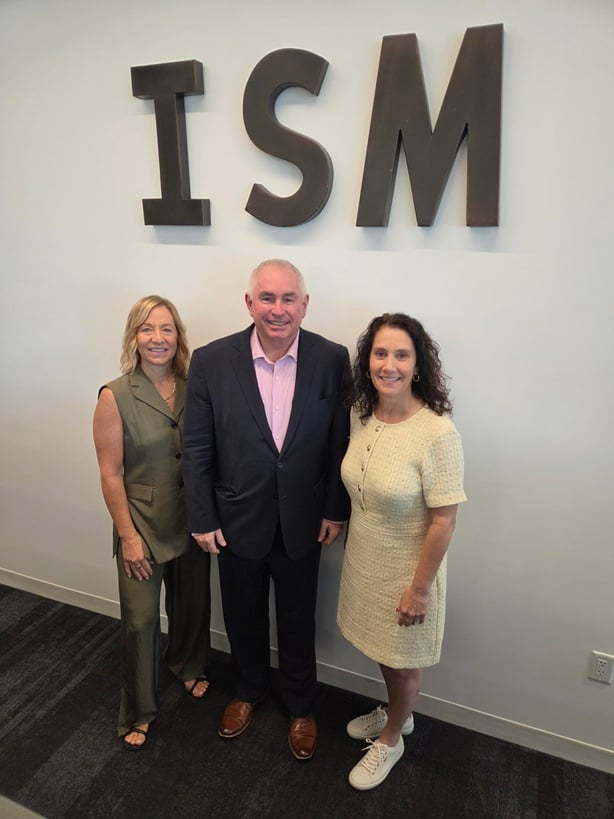
Neal J. Couture, FASAE, CAE, with Institute for Supply Management® (ISM®) Board of Directors Chair Stacey Taylor, MBA, (right) and Vice Chair Michelle Hawkins, PMP. Couture, ISM’s incoming President and CEO, recently met staff for the first time at ISM headquarters in Tempe, Arizona.
Following a comprehensive global search, Institute for Supply Management®’s (ISM®) Board of Directors has named Neal J. Couture, FASAE, CAE, as the organization’s next President and CEO.
Couture, who began his career working in government procurement and contracts, most recently served as CEO of the American Society for Nondestructive Testing, a global association representing more than 35,000 members and certified professionals across 120 countries. His tenure at ISM, the world’s first and largest professional association for supply chain and procurement, begins on October 1.
“As the Board considered ISM’s next chapter, we remained focused on what matters most: our members, the profession, and the future of supply management,” Stacey Taylor, MBA, Chair of the ISM Board of Directors, said in a press release. “Neal brings a strong track record of leadership, innovation and member engagement. His vision aligns closely with ISM’s mission, and we are excited about the opportunities ahead as we continue to elevate the profession, strengthen our community, and ensure ISM remains the leading voice for supply chain excellence worldwide.”
Couture calls leading ISM “a unicorn job,” saying that it’s where his two professional experiences — in procurement and association management — are coming together. “It’s really bringing it full circle,” he says.
Couture spoke with Inside Supply Management® about his vision for ISM, his leadership style and more.
Question: How do you view your role as ISM CEO?
Answer: As a CEO of any association, your job is to lead a profession or an industry. In associations, we have a deeper set of responsibilities that extends to the field, the profession or the industry that our association is the steward of. And ISM is the steward of the supply management field. I have to concern myself with (not only our) members — it goes far beyond members. It’s the companies touched by the work that supply management people do; the people who are beneficiaries of the work that we do. All are concerned that we do that well. And there are a lot of reasons to do that well: organizational success, economic success.
So, that’s where I have to start my focus: Where is the field of supply management at, and where is it going — or where should it go? And work with the volunteers, members and people in that field and industry to help them get there.
Of course, ISM is positioned at the pinnacle. So we have to make sure that organizationally we operate ourselves effectively as well — do we have the right programs, products and services? Do we have the right mechanisms to help achieve that vision that we have for the whole field?
Q: What is the major challenge facing supply chain management?
A: Having resilience, the concept of being able to adjust your systems, processes and operations based on a rapidly dynamically changing environment that is, frankly, out of control. (This can be due to) the effects of globalism, the concept of a global supply chain, and the ability to obtain the materials and goods and services that you need wherever they are available. That availability can change quickly based on dynamics, whether economic or political dynamics.
Tariffs are a classic example: If you’re a battery manufacturer, how do you change where you get your lithium from if all of a sudden lithium is tariffed at 100 percent from the only two places you can possibly get it?
I would extend resilience to include the effects of geopolitics and that the relationships between countries are changing faster than our typical business systems accommodate. …The reality is that geopolitics are changing so quickly that you’ve got to be able to think further ahead. You’ve got to plan for all of the eventualities. You have to be really good at risk management to be able to identify where the risks are in your supply chain. So, I think that from just from the field and the profession, that’s, I think, the first and foremost item.
Q: What challenges are associations facing today?
A: One of the big issues is the concept of community. How do I get people to come back? Once upon a time, you would write your membership check, and next year you’d write your membership check, and the next year you’d write your membership check. It became part of the woodwork. You just did it. And it was because you were expected to belong as a member to your professional field.
What has changed over time is people change their professions. … People today have kaleidoscope careers — they construct their career in an unplanned, perhaps undisciplined, way that makes sense and meaning to them. That may not be a traditional linear path. A person entering the workforce today is going to change their career seven times. I changed my career two or 2½ times. For the current generation, that’s unusual. They don’t want that. They want a different set of experiences that brings meaning to them at whatever stage in life they’re at.
So, we have to look at careers differently.
Now, now overlay that with membership. Are they just going to write their check to you every year? No. You have to find relevance and meaning for them, at whatever point in time that they need you. So that requires us to create a sense of community. (It’s being) relevant to you,
to not only meet your professional needs, but your career needs for whatever time you’re in this career, whether that’s entering or exiting at whatever stage that may be.
It’s a different view of the role of an association other than just simply being a membership organization.
Q: What three words best describe you?
A: First and foremost, transformational. My job is to change whatever I touch for the better — and I hope anyone who’s in any job thinks that way. In my case as a CEO, what the world generally needs now is for organizations to transform into what is needed. And that is intentional, thoughtful and planned out, as opposed to the alternative, which is being a passenger on a freight line going somewhere.
Second, leader. The idea that I, in order to transform, I have to get a lot of people on that ride with me. I have to be able to articulate a vision. I have to be able to make that vision real for everybody, whether it’s the board, the management, the employee, the member, the people on the outside looking in. Leader describes that role of influencing everyone to come along on this shared vision so that we can then transform the organization.
Third, engaging. The idea that, as we go through this experience, I want it to be an enjoyable experience.
The three thoughts — transformation, leadership and engaging — connect together. To me, that’s what my role is, but that’s also who I am as a person, which is to engage deeply in whatever it is I do. I don’t do anything halfway. I don’t do anything by accident. Everything I do is intentional and thoughtful.
I am not going to be a bystander. That’s for someone else. I think that’s one of the reasons that the Board hired me, frankly, is they understand that concept of deep engagement, which is to say, if you’re going to run an organization, you had better know the people, the organizations, the processes, the whole thing.
It doesn’t mean micromanagement. It just means being engaged enough to know when something’s working and when something’s not working and being able to get the right people in place to fix it or whatever. And so as an executive, that’s what I like to do is engage deeply in whatever I do.