New Tariffs, More Volatility, More Planning

One of the constants in the today’s ever-changing manufacturing and supply chain environment is tariffs — and even those are no longer static.
With the 10-percent global Section 122 tariffs having expired at 12:01 a.m. Friday, a new set of tariffs went into effect at the same time. The new tariffs, which impact more than 80 countries, are set at 10 percent to 12.5 percent and are dependent on the country’s efforts to address alleged forced labor allegations, according to an Office of the U.S. Trade Representative release.
How should supply chain organizations handle such volatility? If they haven’t already developed embarked on scenario planning or determined strategies, it’s (past) time to do so, experts say.
“Tariffs aren’t going back to predictable, and the companies successfully navigating this are the ones already able to act on without a team of analysts pulling reports in-between,” says Scott MacFee, CEO at Atlanta-based AI platform provider SpendHQ.
He and other experts offer strategies, frameworks and tips for organizations in all links of the end-to-end supply chain.
Tariff Details
Under the new tariffs, a 10-percent tariff is imposed on trading partners that have made commitments to adopt, and effectively enforce, forced labor import prohibitions. Trading partners that have failed to adopt a forced labor import prohibition have 12.5-percent duties.
While the tariffs cover most imported goods from the impacted countries, U.S. trade representative Jamieson Greer notes that there are exemptions. In addition to fuel, these include some food items and goods compliant with the U.S.-Mexico-Canada Agreement (USMCA) trade agreement.
In the release, Greer said, “Today’s action will begin to correct what is both a human rights abuse and distortive trade practice to improve the welfare of workers everywhere.” Among impacted countries: Argentina, Bangladesh, Canada, Ecuador, India, Indonesia, Japan, Korea, Malaysia, Mexico, Pakistan, Switzerland and the United Kingdom.
Additionally, new tariffs, seemingly not related to ending of Section 122 duties, were imposed last week by the Trump Administration, under Section 338 of the Tariff Act of 1930. According to a White House fact sheet, these amounted to an “additional 50-percent tariffs on certain goods of Canada in response to Canada’s discriminatory treatment of American products.” Hockey sticks, wine and cement from Canada also are subject to the increased tariffs, which are slated to go into effect on or around August 20.
“These Section 338 tariffs apply to all covered goods regardless of whether a good originates under the U.S.-Mexico-Canada Agreement (USMCA),” the fact sheet stated.
Managing Constant Tariff Volatility
MacFee recommends that organizations follow a several-step process that includes:
- Accept that tariffs change
- Know what you buy, where you buy it from and where the supplier is located
- Keep a focus on cost
- Know how tariff rates changes will impact you
- Ensure you are using quality data.
“Tariffs rarely stay confined to the categories they target,” MacFee says. “Most large enterprises won’t see the real impact by looking at the directly affected spend alone, because the exposure sits deeper in the supply chain than the headline rate suggests.”
Tariffs seem to reset every few weeks, making cost something that needs to be constantly managed, he says. When a tariff rate changes, suppliers adjust their handling charges, component costs and product pricing. and those increases tend to show up months later.
“The problem is that most companies work off data that’s fragmented, especially when they only look at high-level supplier totals,” MacFee says. “A category like ‘electronics’ tells you nothing when you need to know whether the tariff hits your finished assemblies or the components you buy from three suppliers in one region. Without that visibility, you can’t isolate where the exposure actually sits, so the decision gets made on whatever data is available instead of what’s accurate.”
For organizations that do it well, the picture is different. They were already at the ready. “They can pull their top suppliers in an affected category and region in minutes, model what a rate change will cost, and reforecast before the variance lands in their budget,” McFee says. “All of that depends on clean, granular spend data.”
A Look at the Retail Side
The worst time to figure out how to handle a supply chain disruption, especially for retailers, is when you’re already in the middle of it, says Timm Reiher, business adviser at Oliver Wight, a business planning consultancy. With continuous market churn, fluctuating tariffs and demand volatility putting significant pressure on cost structures, retailers cannot afford to let current uncertainty discourage them from establishing a long-term integrated planning framework, he says.
“If retailers haven’t anticipated these shifts ahead of time through scenario planning, they are playing checkers while their competitors are playing chess,” he says.
Scenario planning does not have to be overly complex, Reiher says, but it needs to allow leaders to run quick “what-if” models across pricing, demand, tariffs and supply assumptions. This will give them the clear insights needed to make hard decisions before the disruption hits.
With the holiday rush nearly here, it’s best to build organizational resilience beforehand. This requires clear boundaries of accountability, specifically around understanding the difference between a demand issue and supply issue. Demand planning is driven by commercial expectations and supporting assumptions, Reiher says, while integrated planning ensures that pricing, inventory, sourcing and supply chain decisions are aligned around the same assumptions.
“Without these long-term processes in place, there is simply no way to adapt when the peak season collides with sudden market changes,” he says. Success comes down to aligning pricing and demand assumptions, analyzing price elasticity and modeling multiple moves ahead so retailers can respond to tariffs and volatility without making reactive decisions in the middle of the holiday rush.
Other Tips and Thoughts
Use available tools to help. Standard identifiers — global trade item numbers (GTINs) and two-dimensional barcodes — can equip organizations with needed information about the products they buy.
“Companies need the origin of the materials and component parts, and the processing history behind them, to see which products a new tariff rate reaches,” says Melanie Nuce-Hilton, senior vice president of customer success at GS1 US. “These tools not only support regulatory reporting but also enable strategic sourcing decisions, ensuring businesses remain agile in the face of changing import conditions.”
She adds that accuracy is critical, as duties are assessed on the classification and origin declared at entry. “Incomplete data can leave goods that fall outside the tariff potentially assessed at the higher rate, or held at the border while documentation is produced,” she cautions.
Optimize for flexibility. Brian Higgins, U.S. sector leader for industrial manufacturing at KPMG US, notes that because tariffs are now contributing to a more fluid and complex trade environment, manufacturers are placing greater emphasis on designing supply chains that can absorb disruption without constant structural change. He adds, “Sustained volatility has exposed the hidden costs of supply chains that are optimized for cost at the expense of flexibility.”
Understand that global trade is changing. Per Hong, global lead of Kearney Foresight and a senior partner in management consultancy Kearney’s Strategic Operations practice, notes that today’s environment isn’t short-term instability.
“We’re living through a structural transition from one operating system of globalization to the next,” he says. “What’s unfolding in the Persian Gulf looks, on the surface, like another energy crisis. It’s actually the proof of concept for a new architecture of global trade being written in real time, in front of the entire world.”
Canadian tariffs are symbolic, but not inconsequential. While the new Canadian tariffs impact only about 2 percent of total trade from Canada, However, “what’s notable is the justification creep,” Hong says. “We’ve gone from tariffs justified by trade deficits to national security to migration to now wildfire smoke.” Symbolic actions often turn into new norms, he says.
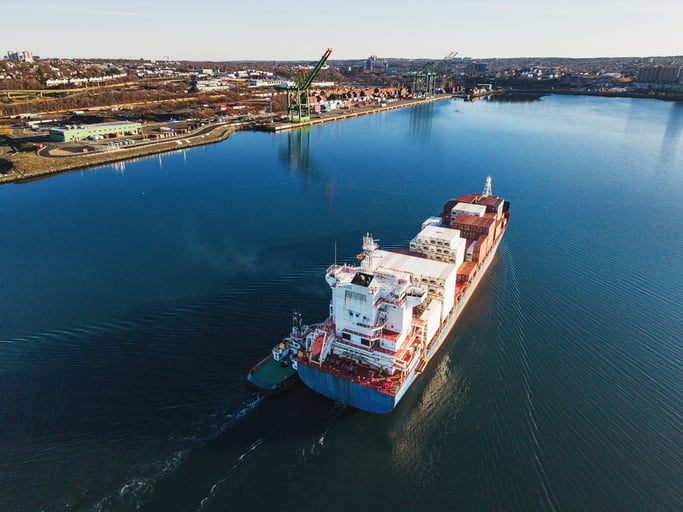
(Photo credit: Getty Images/Shaunl)