
Self-Leadership: A Strategic Tool Amid Change and Burnout


People often think about leadership as the act of leading projects, people, teams and organizations.
But now, more than ever before, leadership starts with the art of “self-leadership.” Everything you do — decision-making, strategizing and deploying visions and plans, engagement with stakeholders — begins with you. It starts in your mind, your attitude, your heart, your personality, your experiences — everything that makes you the person you are. Your leadership is truly yours, unique and authentic.
The world and workplaces are changing at an unprecedented pace. Knowledge and skill needs and expectations are changing as well, highlighting the criticality of self-leadership.
We are surrounded by abundant knowledge and constant change. Rapid technological advancements are transforming our lives in significant ways. Technology has reshaped how we interact, learn, create knowledge, travel, listen to music, shop and manage relationships. These advances have changed routines to such a degree that, in some ways, it’s difficult to imagine life as it was even five years ago.
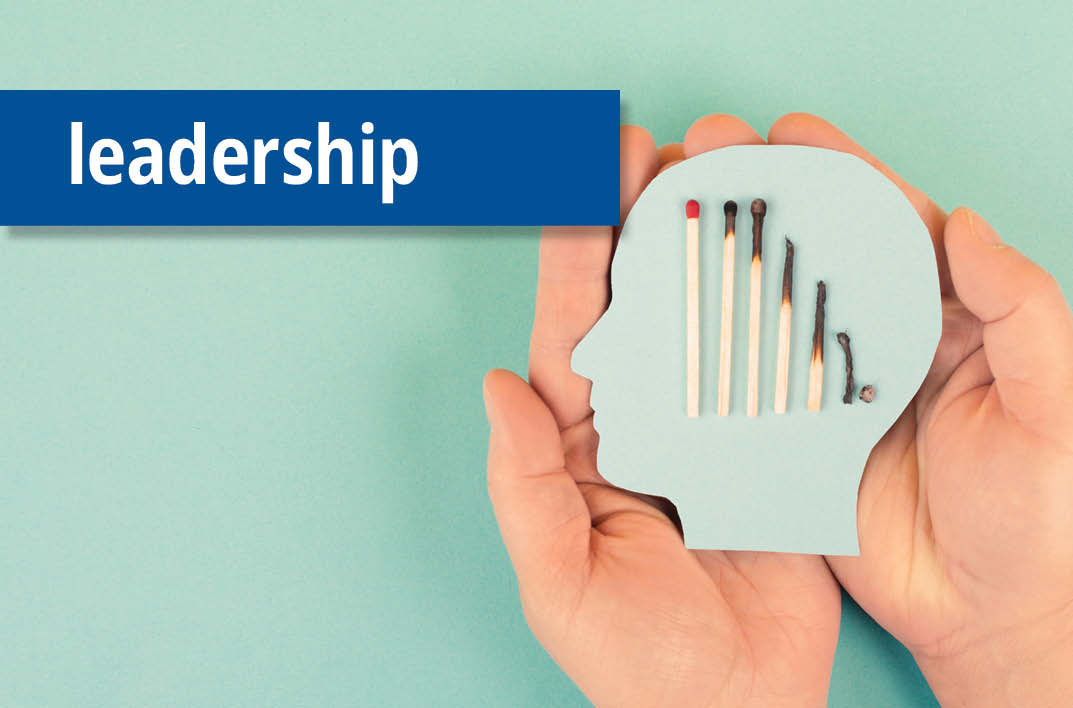
This speed and extent of change can have both a negative and positive impact on us. You could argue that we have created a world in which we are struggling to keep up. As a result, burnout is a common outcome.
Develop Your Strategy
Burnout is considered a state of physical and mental exhaustion caused by stress. What strategies are you employing to foster a healthy culture that prevents burnout?
Burnout is recognized by the World Health Organization (WHO) as a syndrome, an occupational challenge. However, leaders and organizations often view it as a personal issue. Common recommendations are to “reduce stress,” “say no to bosses” and “strive for better work/life balance.”
As burnout becomes more prevalent, it is essential to not just focus on the individual, but to also recognize that it is a growing organizational challenge.
Many leaders are unsure how to define or resolve burnout. Tackling it effectively requires (1) increased awareness and attention to the issue and (2) more inclusion and stronger peer collaboration.
As a leader, you need to develop a comprehensive strategy to address burnout, integrating it into your overall organizational plan and strategy, especially as employee well-being becomes an even more significant issue for company leaders. This requires your best self-leadership.
Banking on Strengths
Burnout often occurs when individuals try to manage responsibilities and solve challenges themselves instead of collaborating. Seeking support from others fosters a sense of shared achievement.
Consider a time you sought assistance — and when you didn’t. What was the benefit of asking for help? What prevented you from doing so? Reflect on whom you should include when collaborating, as well as whether you engage your peers enough. What additional steps can you take to encourage new perspectives and help address the global burnout crisis?
When the world moves quickly, the best thing you can do — to be the best leader you can be — is look to yourself first. Find the strengths within you to lead yourself effectively so that you can lead people and projects (and ultimately, the business) successfully.
A VUCA World
The U.S. military first coined the term VUCA — volatility, uncertainty, complexity and ambiguity — more than 30 years ago. Today, the term is widely used in business and society to describe the fast-paced, complicated and unpredictable world we live in. It highlights the agility you need as a leader to not be overrun or overwhelmed by current turbulence.
Broken down, the concept stands for:
- Volatility — things can change fast and unexpectedly
- Uncertainty — things are unpredictable and non-constant
- Complexity — situations involve many interconnected and complicated parts
- Ambiguity — things can be seen and interpreted in two or more ways.
So, what kind of leadership is needed to lead amid constant change? How can we be that agile?
Bill Joiner is a global thought leader on leadership agility. He oversaw a five-year research project that identified three levels of agile leadership: expert (tactical problem solver), achiever (outcome-focused strategist) and catalyst (strategic facilitator).
Catalyst leaders are the most effective in today’s VUCA environment. They foster high involvement, collaboration, creativity and mutual trust to achieve strategic results. Catalyst leadership teams are role models, shaping and promoting the desired organizational culture. These leaders also coach their teams and regularly assess their own leadership skills to support ongoing development.
Catalyst leaders have the agility, open-mindedness, curiosity and awareness of self and others to explore ways forward on a map that is changing by the minute.
Our behaviors make us unique and authentic. They can be a differentiating factor — a human element that we can control and use to influence. In a VUCA world that is increasingly burned out, self-awareness and self-leadership can help us to stand out and develop into the leaders of tomorrow.
Photo credit: BeritK/Getty Images