Risk Management Is Transforming Supply Chain Organizations

Supply chain organizations need to leverage the capability, wisdom, knowledge and the systems they have to help them deal with the complexity facing them. That complexity translates into risk — and it’s coming at top speed from all angles.
“We are dealing with change, we’re dealing with conflict, we’re dealing with challenges day in and day out,” said Jim Fleming, CPSM, CPSD, a former Manager, Product Development and Innovation at Institute for Supply Management® (ISM®). “And the rate at which they’re coming at us is still exponential.”
In one of his last duties at ISM — he retired last week — Fleming moderated “Quarterly State of Risk Update,” featuring Matthew Bey, senior global analyst and head of methodology at global risk intelligence company Rane Network. The July 14 webinar centered around supply chain conflicts, covering such topics as geopolitics, the feasibility of shifting all operations from China, visibility and the use of AI, and tariff volatility.
“The risks we have in supply chain and supply management are real and have a magnitude of impact that is greater than a lot of corporations have ever dealt with in the past,” Fleming said.
Organizations are becoming more strategic, informed and aware in their risk management. They are “starting to see some — I wouldn’t say it’s light at the end of the tunnel, but there is light. … More and more organizations that are getting a seat at the table when it’s in that risk conversation,” he said.
Among the key takeaways:
Geopolitics. Companies impacted by the volatility in the Middle East, particularly the closing of the Strait of Hormuz, are shifting from a just-in-time strategy to a new norm characterized by supply chain delays, Bey said.
The Gulf Cooperation Council countries “are going to be investing massively over the next few years on alternative supply chain routes to avoid this trade reform, whether it be existing or expansion of existing pipelines or railways,” he said. This will “reshape the map” in many ways, he added.
Sourcing. Organizations are taking a more end-to-end approach to their supply chains than in the past, Fleming said. They realize they must not only understand the source and category, but must also take into account logistics, warehouse strategies, sales and operations planning, he said.
“We’re becoming more of a holistic supply chain organization and expanding our focus there, which really gets us into needing more skills than we have traditionally,” Fleming said. “And we’re seeing more companies integrating some of these other functions into a standard procurement organization.”
China shift and tariffs. With China a large focus during President Donald Trump’s first term, there was an expectation that the country would again be a focus, so organizations started shifting their production and sourcing out of China. However, moving to other countries or regions doesn’t necessarily solve volatility issues.
“What’s happening is that we are now realizing there is no utopia out there,” Fleming said. “All regions have risk.” The second administration has focused a lot on tariffs — and volatility “exists inside of the world of tariffs.” Bey added that tariffs have been levied on nearly every single country the U.S. trades with — and that it’s difficult for companies to separate their supply chains from China.
Visibility. Greater visibility can enable companies to gain more insight and due diligence into their lower-tier supply chains and where their raw materials come from.
Take, for example, rare earths, which often are subject to geopolitical volatility. Many organizations have no idea if their supply chain includes rare earth materials, Bey said. Many are turning to AI to create that visibility, he said, as well as help them manage other risks.
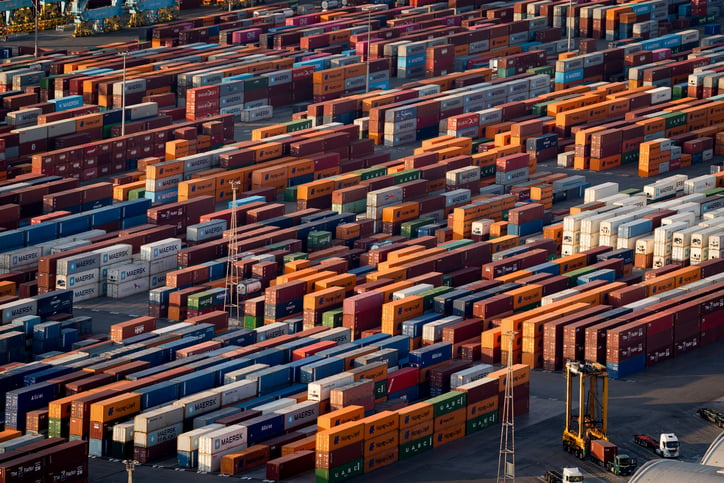
(Photo credit: Getty Images/BeingBonny)