
Beyond Hours Saved: What Procurement AI Must Prove in 2027
The answer that doesn't land
Ask a procurement team what AI has done for them and you'll usually hear the same answer: it saves us time. RFx drafts come together faster. Supplier research takes minutes, not days.
That is real. But when a manager asks what changed as a result, or a CFO asks where it shows up, the answer runs out. Saved hours rarely reach a scorecard. They get absorbed by the next request, the next meeting, the next fire.
The gap shows up at every level. A buyer can't show a manager what improved, and a CPO can't show the CFO. Proving AI's impact means looking past the hours to the work itself.
Everyone wants proof. Few are measuring.
Ardent Partners asked procurement leaders what moved AI from pilot into production. The most common answer, from 61% of CPOs, was clear and proven ROI.
Yet in The Hackett Group’s new Autonomous Sourcing Index, built on insights from 100+ CPOs, only 10% say they measure agentic AI performance consistently across deployments. The full Index launches at PLAN, a free virtual event on 18 November, where you can see where your own organization scores.
The condition that unlocks AI investment is proof, and the habit that produces proof is missing. Gains get reported as anecdotes, and anecdotes rarely survive a review. The risk is not that AI fails. It is that AI works and nobody can show it.
Why the impact stays invisible
The Index scores organizations from 0 to 10 on how they deploy, orchestrate and scale AI in sourcing. The median is 3.6: use is repeatable, but foundations are still forming. Three things keep the impact hidden.
- Reach. Agents often work inside one tool or one step. A faster RFx draft does not shorten a sourcing cycle that still waits on approvals and supplier follow-ups. The hours saved are real, but the process is no faster.
- Data. Both Hackett and Ardent found data quality is the barrier cited most often. Output built on fragmented supplier data gets double-checked, which quietly eats the time saved.
- Insight without action. Teams report the broadest gains in intelligence: faster category, supplier and market insight. Turning insight into savings needs agents that execute work within clear guardrails, not just recommend it.
Four ways to make the impact visible
None of these needs a new tool, and a category lead can own them as readily as a CPO.
-
Record your starting point
Before AI touches a process, write down how it performs today: cycle time, savings, share of spend competitively sourced, contract compliance and policy exceptions. It takes weeks, and it turns "it feels faster" into a before-and-after.
-
Measure the process, not the tool
Track the outcome the process exists to deliver, not prompts run or hours logged. If AI drafts RFx documents, measure time from request to award. If it screens suppliers, measure qualified bids per event.
-
Point AI at work that never got done
Ardent finds only about half of addressable spend goes through a formal sourcing process. The rest isn't ignored on purpose; teams lack the hours. This is where saved time becomes visible results: tail spend, repeat buys and renewals that finally get competed. Run one such area end to end, with trusted data, clear guardrails and an executive sponsor, then scale only what meets the thresholds you set.
Leaders from IBM and Kimberly-Clark will unpack what it takes to move agents from pilot to production at PLAN on 18 November.
-
Decide who decides
Ardent also found 34% of organizations using AI have no formal AI governance framework. Agree which sourcing decisions an agent may make alone, which need human approval, and what audit trail you need. Clear rules let lower-risk work move faster, and that is where measurable change appears first.
Measure, then predict
The coming weeks will bring a wave of 2027 predictions for procurement AI. Each is only useful against your own baseline.
So try four questions. Could you show, with numbers, what AI changed in your process this year? Do your agents work across intake, sourcing and contracts, or inside one tool each? Would you trust your supplier data to drive a decision unchecked? Has anyone written down what an agent may decide alone? Two or more "no" answers point to foundations before features.
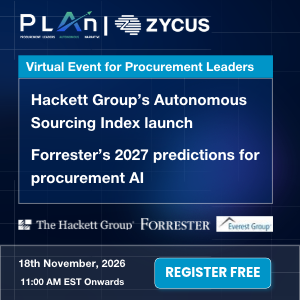
These four questions give you a quick read. To put a real number on it, join PLAN by Zycus on 18 November, a free, global virtual event under three hours. The Hackett Group launches the full Autonomous Sourcing Index, Forrester shares its 2027 predictions for procurement AI, and leaders from IBM and Kimberly-Clark join Everest Group on what it takes to move agents from pilot to production. Attendees receive their own Index score and a 2027 readiness plan within 24 hours, and earn 2 CEH credits. Register and your plan arrives the same way.
Set your baseline today, so that next year you can answer with numbers.