
Supply Chain Roundtable: Freight, Frights and 47-Tab Spreadsheets

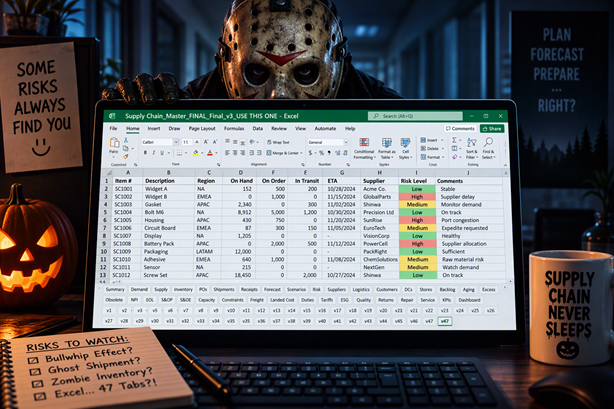
It might be hyperbolic to equate a supply chain setback to being a victim in the seemingly endless string of “Friday the 13th” slasher films that paraded through theaters a generation ago, but this is the season for such comparisons.
For this Halloween-themed edition of Institute for Supply Management®’s (ISM®) monthly Supply Chain Roundtable, our panel of experts is on the lookout for the figurative hockey mask-wearing and axe-wielding terror lurking behind any potential transaction or shipment. They are:
- Michelle Rohlwing, MBA, ISM Manager, Product Development, Innovation and Learning
- Teresa O’Brien, ISM Senior Faculty Member, Product Development and Innovation
- Naseem Malik, MBA, CPSM, senior sourcing director at Baylor Scott & White Health in Dallas
- Collins Oluka, MBA, CPSM, vice president of procurement — North America and global chemicals group at Avery Dennison and Chair of ISM’s Strategic Sourcing and Supply Relationship Management Council.
The first question details a long-running horror story for procurement organizations — sourcing and selling in a contradictory environment in which business data and sentiment are significantly misaligned. Procurement talent and rail freight are other topics of discussion.
Lastly, the visit to supply chain’s Camp Crystal Lake concludes with a warning that a villain or monster could be hiding anywhere, including your computer screen.
Q: Nearly all year, the ISM® PMI® Reports data has documented a not-so-subtle divergence: The numbers say new orders and business activity are growing strongly, while sentiment has been in the dumps as panelists bemoan the challenges of doing business and sourcing supply. Have you seen this type of environment before, and what can organizations do besides grin and bear it?
Malik: I’ve seen versions of it, but health care lives in this gap full time. Patient volume rarely slows down, so demand is never the problem. The problem is that every dollar of growth takes more effort to deliver than it did a few years ago. When it comes to price increases, back-orders, substitutions and new supplier vetting, the PMI® numbers capture the volume. The sentiment captures the effort per transaction. Both are true. So I’d treat the gloomy comments as data, not noise. If we ask our buyers where friction actually lives, we’d find a good share of it inside the building — for example, approval loops, price change churn and handoffs between teams. The market won’t get easier on its own schedule. Your process can get easier on yours, and that’s the fastest way to close the gap between what the numbers say and how the team feels.
O’Brien: I think we've experienced similar challenges before, but what stands out today is how much uncertainty has become part of everyday business. Organizations can't control everything happening around them, but they can control how prepared they are to respond. For me, that starts with the fundamentals of (1) better visibility into supply risks, (2) stronger collaboration across the business and (3) using technology to identify issues before they become disruptions. It's really about moving from constantly reacting to being more proactive. This focus does not change for our profession, in any economy.
Oluka: One term I have heard being used to describe the current environment is a “kangaroo market” — choppy, volatile and bouncing erratically, despite strong headline demand. This current environment reminds me of the 2021-22 post-reopening surge, where order books overflowed but procurement teams faced severe burnout from port bottlenecks, component shortage and runaway input costs. Revenue was expanding, but fulfillment felt like a perpetual crisis. Organizations should transition from ultra-lean operating models toward calculated resilience. Rather than shifting between lean inventories and panic buying, successful organizations conduct TCO audits to hold strategic buffers on critical single-source materials while dual-sourcing commoditized inputs closer to demand centers. Also, introduce flexible surcharge or index clauses in customer contracts, so the operational burden is shared across the commercial side rather than being dumped entirely on procurement.
Rohlwing: I think we’ve certainly seen challenging times before, but this environment feels different because the business is there, even though it might not always feel that way. Companies are still dealing with higher costs, supply challenges and a lot of uncertainty, which naturally impacts how people feel about the market. The best thing organizations can do is stay flexible, build stronger supplier relationships, have backup options and focus on the things they can actually control. Unfortunately, uncertainty might just be part of the new normal.
Q: ISM’s 2026 Salary Survey will be out soon to spotlight the supply management employment and compensation landscape. What are you seeing in terms of demand for supply chain and procurement talent? Which positions or skill sets are proving particularly difficult for employers to find?
O’Brien: I think we’re seeing a real shift in what makes a successful procurement professional. Technical expertise is still important, but organizations increasingly need people who can connect technology, data and business strategy. AI creates tremendous opportunities, but it also requires people who are curious, adaptable and willing to rethink how work gets done. It’s hardest to find someone who can lead that change while bringing people along with them.
Malik: A lot of companies are searching for a candidate who doesn’t exist. The job description lists sourcing, analytics, AI, ERP, negotiation and stakeholder management, then the salary band covers about half of it. We’re aiming to hire for judgment and coachability and teach the tools, as the tools change every few years and judgment compounds. Also, in health care, the hardest profile to find is someone who can hold their own with a surgeon, a pharmacist or a lab director and earn trust in that room. Category knowledge can be learned, but clinical credibility takes time. The cheapest talent strategy out there is keeping the good people you already have.
Rohlwing: Demand is still strong, but employers are looking for a different mix of skills than they were even a few years ago. The harder roles to fill seem to be those that combine solid procurement and supply chain experience with data analytics, technology and AI, strategic sourcing, risk management and emotional intelligence. It’s becoming just as important to be able to build relationships, communicate and influence others as it is to have technical skills. Finding someone who can bring all of that together and think strategically can be challenging.
Oluka: Michelle makes a great point, and here is another way to look at it. What companies are looking for has fundamentally changed. Procurement has evolved to a strategic value creation function, and today’s practitioners are expected to (1) protect earnings before interest and taxes against persistent volatility, (2) de-risk multi-tier networks, (3) drive Scope 3 sustainability, (4) enable innovation and (5) embed generative AI into their daily workflows. It’s increasingly difficult for employers to find procurement professionals/leaders who are multidimensional, can look beyond their functional goals and objectives, understand broader business goals, and balance both functional and business agendas under pressure. In procurement and supply management, demand will remain constant for professionals possessing solid business acumen, financial literacy, sharp analytical capabilities and strong communication skills.
Q: An article in the September/October issue of Inside Supply Management® discusses a rail freight renaissance. If rail and intermodal are becoming more competitive with truckload, what should supply management organizations be doing to maximize shipping and logistics efficiency, rather than simply chase short-term savings?
Oluka: The strategic error is treating rail and truckload as an either/or choice. If organizations want to capitalize on this intermodal renaissance, they have to evaluate freight through the lens of total cost of fulfillment. Rail trades transit speed for massive volume economics and significant carbon reductions. That means your total landed cost model must incorporate working capital, pipeline inventory carrying costs, dwell times, and safety-stock adjustments at distribution centers and plant sites. Leading organizations are capturing real value by synchronizing upstream with suppliers and downstream with customers and aligning lead times and delivery expectations across the entire value chain. They leverage a bimodal strategy whereby rail transports steady, predictable base-load volume while they reserve truckload for high-volatility, time-sensitive surges.
Rohlwing: It shouldn’t always be about chasing the cheapest freight rate. Organizations should be looking at where rail, intermodal and truckload each make the most sense based on cost, timing, reliability and customer expectations. Having more options also gives companies greater flexibility when disruptions occur.
Malik: In health care, most of our freight never shows up as freight. It’s baked into the unit price from the distributor or manufacturer, so a shift toward rail can lower a supplier’s cost without our price ever moving. That’s where I’d start: Find out where freight lives in your spend. Ask suppliers how their inbound volume moves and how much transportation cost sits inside the price you pay. Heavy, bulky, predictable products are natural candidates for rail, and if a supplier’s landed cost drops, that should show up in the next negotiation instead of quietly widening their margin. Then check your terms. Who owns freight, when title transfers, and whether you can get the transparency to see cost changes. Collins mentioned index clauses on the customer side. On the buy side, they should work in both directions. Isn’t it funny how they only seem to get invoked when costs go up?
O’Brien: I see this as another opportunity for procurement and supply chain teams to work more strategically across the business. It’s not just about finding a lower transportation rate; it's about understanding how transportation decisions affect inventory, service levels and overall costs. Better planning, stronger collaboration with logistics partners, and using data to evaluate different scenarios can help organizations make smarter decisions that deliver value beyond immediate savings.
Q: For a little Halloween fun: Every horror movie has something the characters should have seen coming. What’s the supply chain risk or annoyance always lurking out there but hard to prepare for? A bullwhip effect, ghost shipment, zombie inventory or the (gasp!) Microsoft Excel spreadsheet with 47 tabs?
Rohlwing: I’m speaking from experience when I say forget the bullwhip effect and ghost shipments. The real annoyance is the Excel spreadsheet with 47 tabs, five different owners, formulas no one understands, and one tab called “FINAL_Final_v3_USE THIS ONE.” And, of course, the person who created it left the company two years ago.
O’Brien: Michelle’s spreadsheet example is frighteningly familiar! But I’d add the procurement system that was supposed to automate everything, yet somehow still requires 15 manual workarounds, three spreadsheets and someone who knows the secret process to make it all work. The real horror? Everyone says, “That's just how we’ve always done it!”
Oluka: This is a great question. Forget zombie inventory or 47-tab spreadsheets, the true horror story is Tier-N concentration risk, the horror plot where all the characters think they are running in different directions, only to discover they are trapped in the exact same room. Organizations love to boast about dual-sourcing at Tier-1 to diversify risk across multiple suppliers. But if you actually map the bill of materials down to Tier-3 or Tier-4, both of your primary suppliers are often buying their key substrate, microchip packaging or active chemical ingredient from the exact same supplier. When that single hidden node goes dark, the entire industry gets caught in the same nightmare simultaneously. That hidden dependency is the monster that keeps supply chain executives awake at night.
Malik: Michelle and Teresa have the haunted office covered, and Collins found the monster in the basement. Mine is the zombie contract. It either expired quietly or auto-renewed on an evergreen clause nobody remembered. Either way, it’s still walking around. Pricing hasn’t been touched in years, the supplier has changed names twice through acquisitions, and the signed pricing exhibit lives in a folder no one can find. Nobody notices until an increase letter shows up, and you realize you had no protection to begin with. The cure isn’t glamorous — it’s a contract calendar someone owns and a 180-day look-ahead on everything expiring. The best zombie repellent? A reminder that someone actually reads.
(Image created with Microsoft Copilot)