
The ‘Cost-Out’ Mirage: The Hidden Price of Aggressive Sourcing


Every procurement leader is familiar with the quarterly review where a double-digit price reduction draws applause.
Purchase price variance runs green, the category manager is congratulated, and the deck advances. Twelve months later, however, quality is absorbing warranty claims, operations is paying expedite premiums, and no one traces those costs to the sourcing event that produced them.
I am not arguing that the savings were invented. I am arguing that we drew the accounting line in the wrong place, then congratulated ourselves on what fell inside it.
The Mandate Is Legitimate
Cost reduction remains procurement’s leading enterprise priority, named by 72 percent of the 260 chief procurement officers in Deloitte’s 2025 global survey. The Hackett Group’s 2025 benchmarking found top-quartile organizations generating 2.6 times the ROI of their peers and roughly twice the savings as a share of spend. Any argument treating sourcing leverage as inherently destructive is arguing against the evidence.
The differentiator, however, is not ferocity at the table. John Henke, Sengun Yeniyurt and Chun Zhang in 2009 tracked price reduction demands and the concessions granted over seven years to 238 suppliers to the six major North American automakers. Suppliers conceded more to buyers who had aligned processes with them and given them reason to expect future business. Adversarial pressure did not produce the largest reductions. Credible partnership did.
Cost-shifting has a recognizable anatomy. Procurement is measured on a unit price that is easy to isolate and verify. Its consequences land in accounts that are neither: downtime, scrap, expedite premiums, safety stock, rework, warranty reserves and churn. No single ledger reconciles the two.
Aggression is what makes that gap expensive. A modest reduction rarely strains a supplier. A double-digit one, repeated annually, changes what the supplier must do to keep the account.
The displacement is measurable in aggregate. World Commerce and Contracting, in association with Deloitte, put average contract value erosion at 8.6 percent across more than 1,200 organizations. When displacement becomes disruptive, the scale changes.
Cost-shifting converts across sectors. Carillion, the second largest contractor in the United Kingdom (U.K.), entered compulsory liquidation in January 2018, owing close to 7 billion pounds against just 29 million in cash, holding 420 public sector contracts across hospitals, schools, roads and prisons. The roughly 30,000 suppliers that were owed around 2 billion pounds recovered almost none of it, having been held to 120-day terms by a signatory of the U.K.’s prompt payment code.
What should trouble procurement is what happened even as the warning signs became harder to ignore. In the Carillion case, the company issued a major profit warning in July 2017, initially announcing write-down on contracts valued at an 845 million pounds. In the months that followed, Carillion announced 1.9 billion pounds in new government work, although many of those contracts had been agreed before the warning.
The episode illustrates the danger of procurement decisions that do not adequately account for supplier financial resilience alongside price and contractual compliance. As a U.K. House of Commons report later concluded, “Carillion’s business model was a relentless dash for cash, driven by acquisitions, rising debt, expansion into new markets and exploitation of suppliers.”
Redrawing the Line
My doctoral research examined procurement integrity across 28 public sector organizations in five South Florida counties. The jurisdiction is narrow, so treat what follows as an observation to test locally rather than a finding that travels. Within that sample, I found a pattern: Pressure applied to a supply base does not dissipate, it changes form.
In “The Dark Side of Buyer Power: Supplier Exploitation and the Role of Ethical Climates,” a 2015 Journal of Business Ethics article, Martin C. Schleper, Constantin Blome and David A. Wuttke locate the difference between commercial bargaining and supplier exploitation in a firm’s ethical climate.
The Association of Certified Fraud Examiners found corruption in 48 percent of 1,921 cases investigated, at a median loss of US$200,000. A supplier pushed past viability substitutes materials, subcontracts to a facility you have never audited, or finds someone inside your organization willing to help.
Notice what none of that evidence does: No study yet traces a specific price concession to the cost it created three functions away, because almost no organization equips itself to produce that data. The absence is not a hole in the argument. It is the argument.
Three things must move. The CFO owns the number, because procurement does not control the ledgers where displaced costs land — and no category manager can charge a warranty reserve against an award made two years earlier. The data must carry three identifiers — supplier, item and contract — end to end, or no analytics investment will reconstruct what an award cost. (See chart below.)
What to Put in Motion This Quarter
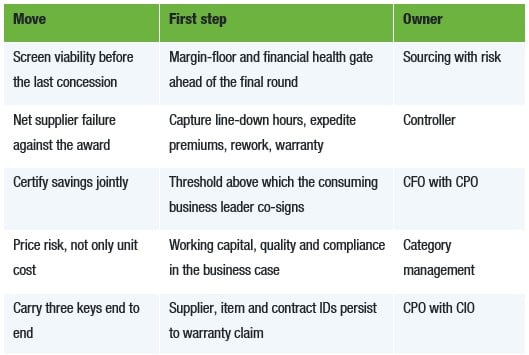
Courtesy of Lenora Sevillian, LP.D., MBA, CIPP, CPPP, CPCM
And the negotiator becomes a business architect, writing the business case before the market is approached, carrying working capital, quality and compliance as line items someone must defend.
The first two cost little and generate the evidence that funds the last, which needs investment and a sponsor outside procurement.
As long as procurement is measured on purchase price variance, the function will optimize for purchase price variance, and the enterprise will absorb what that optimization displaces. Aggression is not the problem. Aggression measured against the wrong boundary is. Until we move it, we will go on applauding a number that was never the whole number.
(Image credit: Getty Images/Frentusha)